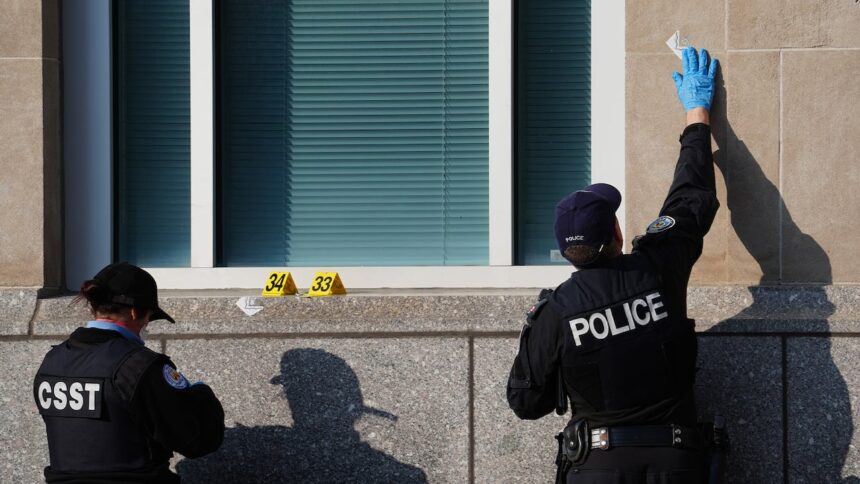

I walked past the U.S. Consulate on University Avenue just last week, like I’ve done countless times covering downtown stories. The building always had a quiet, fortified presence. Today, that corner of Toronto became a crime scene that shook our entire city.
Early reports indicate a shooting occurred near the consulate, sending shockwaves through the financial district and beyond. Heavily armed police officers swarmed the area within minutes. Office workers stood frozen on sidewalks. The usually bustling streets fell eerily silent except for sirens.
Toronto Police Chief Myron Demkiw addressed media this morning, confirming the incident involved gunfire directed at the consulate building. No consulate staff were injured, according to initial reports. One suspect was quickly taken into custody. The swift response prevented what could have been a far more tragic situation.
“This is an active investigation with national security implications,” Chief Demkiw stated during the hastily arranged press conference. His words carried weight that extended beyond typical police briefings. Federal agencies joined the investigation immediately.
The consulate sits in the heart of Toronto’s downtown core, surrounded by hospitals, businesses, and thousands of daily pedestrians. University Avenue transforms into a canyon of glass towers and historic institutions. The discovery district sprawls nearby. MaRS innovation hub operates just blocks away.
I’ve covered plenty of Toronto crime stories over my years with LCN.today. Bank robberies, corporate scandals, even protests that turned rowdy. This feels different. The targeting of a diplomatic building on Canadian soil carries implications that ripple far beyond our city limits.
Mayor Olivia Chow released a statement within hours, emphasizing Toronto’s commitment to safety and diplomatic protocol. “We stand with our American neighbours and all diplomatic missions,” she said. Her office coordinated closely with federal officials throughout the morning.
The RCMP arrived on scene alongside Toronto police, their presence signaling federal jurisdiction over matters involving foreign diplomatic properties. Yellow police tape cordoned off several blocks. Transit routes were diverted. The PATH underground system sections near the area were temporarily closed.
Witnesses described hearing what sounded like firecrackers around dawn. Sarah Chen, who works at a nearby law firm, was arriving early for a deposition. “I thought construction workers dropped something metal,” she told reporters. “Then I saw police cars coming from every direction.”
The consulate building itself remained locked down for hours. Staff inside were safe but understandably shaken. Consular operations handle thousands of visa applications monthly. Canadian citizens seeking U.S. travel documents. American citizens requiring passport renewals. Business visas for cross-border commerce.
Toronto maintains deep economic and cultural ties with American cities. Our business communities are intertwined. Supply chains cross the border continuously. The consulate facilitates countless transactions that keep both economies humming. Any threat to that diplomatic presence reverberates through corporate boardrooms and small businesses alike.
Security experts I’ve spoken with over the years always warned about Toronto’s potential vulnerability. We’re Canada’s largest city. We host major international events. Diplomatic missions from over 90 countries operate here. Yet we’ve largely avoided the violence that plagued other major world cities.
Dr. Michael Kempa, a criminology professor at the University of Ottawa, commented on the broader security implications. “Diplomatic facilities represent sovereign territory,” he explained in a phone interview. “Any attack requires coordinated response between multiple law enforcement levels.”
The downtown core gradually returned to normal operations by afternoon. Office towers reopened. Transit resumed regular routes. But an invisible line had been crossed. Torontonians who previously walked past the consulate without a second thought will now notice the armed guards more carefully.
I grabbed coffee at my usual spot on King Street after the police perimeter expanded. The barista, Marcus, asked if I knew what happened. Everyone was checking their phones. Group chats exploded with speculation and concern. This is how news travels now, through digital networks faster than traditional media can verify facts.
The business implications extend beyond immediate security concerns. Toronto’s financial district depends on perceived stability. International investors factor political and security risks into their decisions. Bay Street firms reassured clients throughout the day. Conference calls with New York and London offices addressed the incident.
Fashion Week Toronto is scheduled for next month. Major cultural festivals approach. The consulate shooting raises questions about security protocols for large public gatherings. Event organizers will certainly review their emergency plans.
Federal Public Safety Minister Dominic LeBlanc addressed Parliament this afternoon, confirming the government takes the incident with utmost seriousness. “We’re working closely with American officials,” he stated. Intelligence agencies were analyzing any potential broader threats.
The suspect’s identity and motives remain under investigation. Police declined to release details that might compromise their work. The coming days will reveal whether this was an isolated incident or part of something larger.
Toronto has always prided itself on being a safe, welcoming international city. We host the world here. Our diversity is our strength. But today reminded us that global tensions can manifest on our streets. The distance between international conflicts and our downtown corner feels suddenly smaller.
University Avenue will return to its normal flow. Streetcars will rattle past. Hospital workers will hurry between shifts. The consulate will resume its quiet diplomatic work. But something shifted today in our collective understanding of vulnerability.