
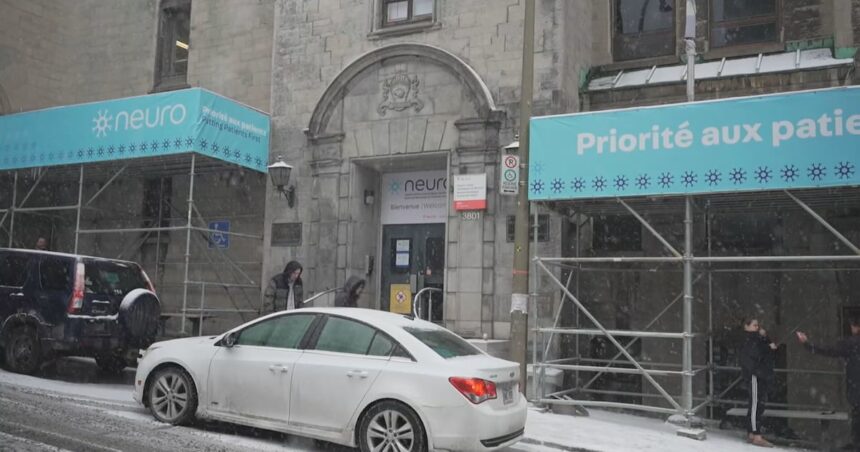

I’ve been walking past the Montreal Neurological Institute for years, watching its elegant stone facade catch the winter light on University Street. It never occurred to me that behind those historic walls, medical staff were navigating what amounts to an infrastructure crisis.
The McGill University Health Centre just revealed plans to relocate The Neuro from its downtown location to the Glen site. This isn’t a minor renovation discussion. We’re talking about a $1 billion construction project that could reshape neuroscience care across Quebec.
Dr. Justin Letourneau works in The Neuro’s intensive care unit. He told reporters the space feels trapped in another era. The ICU still uses curtains instead of proper walls. Patients lie separated only by fabric, their most vulnerable moments exposed to strangers.
“This space is decades old and we’re struggling,” Letourneau explained. His team delivers exceptional care despite working in conditions that would shock most Montrealers.
The negative pressure rooms present a particular problem. These specialized spaces prevent airborne infections from spreading throughout the hospital. At The Neuro, they’re too cramped to function properly by modern standards.
Current ICU design calls for closed rooms with substantial square footage. The Neuro operates with an open layout common in the 1980s and 1990s. Privacy has become nearly impossible to guarantee.
I remember visiting a friend at the Glen site last spring. The contrast with older hospitals was striking. Wide hallways, natural light, private rooms designed with patient dignity in mind. The Neuro’s facilities haven’t kept pace.
The building’s downtown isolation creates operational challenges beyond aesthetics. There’s no on-site laboratory. No blood bank exists within the facility. Neurologists work without easy access to other medical specialists.
Dr. Lucie Opatrny serves as MUHC President and CEO. She points to this geographical separation as a fundamental flaw. When patients need urgent blood work or consultations with cardiologists, precious time gets lost.
The ambulance bay situation borders on absurd. Paramedics arriving with critical patients share outdoor space with delivery trucks. Imagine trying to unload someone experiencing a stroke while navigating around a supply shipment.
Maxime Boutin-Caron is the associate director of the neuroscience program. He described the scene as “a game of rush hour.” Staff coordinate vehicle movements like puzzle pieces. It works, but barely.
“It’s doable, but it’s a lot of logistics for something that should be streamlined,” Boutin-Caron said. He’s right. In 2025, our premiere neurological hospital shouldn’t operate like a loading dock.
Then there’s the pharmacy leak. Part of The Neuro’s newly renovated pharmacy remains closed. Water seeps through somewhere in the structure. Despite multiple investigations, maintenance crews can’t locate the source.
One third of this brand-new pharmacy has never opened. The space sits empty while water continues infiltrating. Boutin-Caron confirmed the problem persists despite numerous interventions.
These aren’t cosmetic complaints. They represent serious obstacles to patient care and medical safety. The MUHC believes relocation offers the only viable solution.
The proposed move would unfold in two phases. Phase one carries a $250 to $300 million price tag. This covers the primary hospital construction and patient care facilities.
The remaining $700 to $750 million would fund ambulatory care centers and research laboratories. The Neuro has built an international reputation for neuroscience research. Those programs need modern facilities to continue advancing.
Santé Québec responded with a carefully worded statement. “Discussions and analyses are currently underway regarding this matter,” their spokesperson confirmed. The phrasing suggests cautious interest without commitment.
Dr. Opatrny acknowledged a significant hurdle. The project doesn’t appear on Quebec’s current infrastructure plan. Recognition of need doesn’t automatically translate to funding approval.
“It’s really to see how to go from recognizing the need, to making it on that list,” Opatrny explained. That list determines which major projects receive provincial backing.
I understand the hesitation. One billion dollars represents substantial public investment. Quebec faces competing healthcare demands across the province. Rural hospitals need upgrades. Long-term care facilities require expansion.
But Boutin-Caron raised a point worth considering. The Neuro serves far beyond Montreal’s boundaries. More than half its patients travel from outside the island.
This facility treats some of Quebec’s most complex neurological cases. Stroke victims, brain tumor patients, people with epilepsy and Parkinson’s disease all depend on The Neuro’s specialized expertise.
When someone in Trois-Rivières or Sherbrooke suffers a severe neurological emergency, they often end up on University Street. The care quality remains exceptional. The infrastructure supporting that care has become dangerously outdated.
The Glen site offers logical advantages. The Neuro would operate alongside other MUHC facilities. Laboratory services, blood banks, and diverse specialists would sit minutes away instead of across town.
Ambulances could deliver patients through proper emergency bays. Research teams could collaborate in modern laboratories. ICU patients could recover in private rooms with space for family members.
Walking through the Plateau last week, I overheard a conversation at a café. Two nurses discussed working conditions at various Montreal hospitals. One mentioned The Neuro with obvious affection and frustration. Great team, impossible building.
That tension captures this situation perfectly. Montreal built this institution’s reputation on brilliant minds and dedicated staff. They’ve compensated for inadequate infrastructure through sheer professional commitment.
But compensation has limits. Medical technology advances rapidly. Treatment protocols evolve. Facilities designed for 1980s healthcare can’t properly support 2025 medicine.
The question becomes priority and timing. Does Quebec’s infrastructure list have room for a billion-dollar neuroscience campus? Can the province afford to let The Neuro continue deteriorating while other projects advance?
Dr. Opatrny and her team clearly believe this move represents necessity rather than luxury. They’ve opened their facility to media scrutiny, revealing problems most institutions prefer hiding.
That transparency suggests urgency. The MUHC wants Quebecers understanding that downtown charm can’t substitute for functional medical infrastructure.
Santé Québec’s ongoing discussions will determine whether this vision becomes reality. Provincial decision-makers must weigh The Neuro’s specialized role against countless competing needs.
Meanwhile, staff continue delivering world-class neuroscience care behind those elegant stone walls. They navigate tight spaces, coordinate around delivery trucks, and work around an unfindable water leak.
It’s a testament to their skill that patients receive excellent treatment despite these obstacles. It’s also a reminder that even our most prestigious institutions sometimes operate on borrowed time.