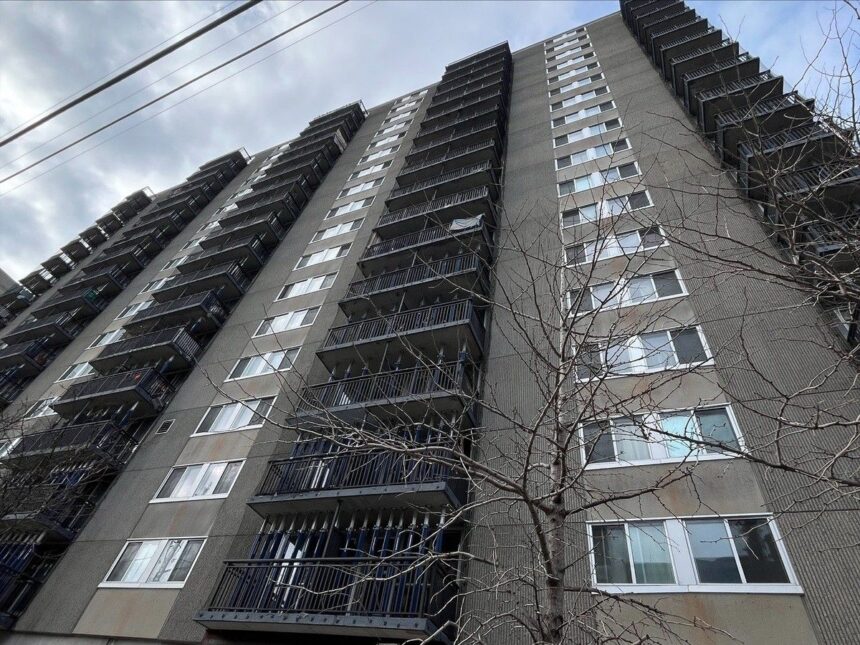

The acrid smell of smoke still clings to everything on the 19th floor at 395 Somerset Street West. Three blue HEPA 500 portable air-filtration fans work overtime, their constant hum a reminder of what happened here. Unit 1916 was where three residents lost their lives on March 14. The tragedy has left an entire building shaken and struggling.
Walking these halls now feels different than it did just weeks ago. The smoky odor permeates the stairwells and corridors despite the industrial fans running day and night. Some residents haven’t been able to return home yet. They’re scattered across temporary housing throughout the city, their lives upended in a matter of hours.
Dan Galarnyk knows that disruption all too well. His apartment sits directly below the unit where the fire broke out. That night, water from firefighting efforts began flooding into his 18th-floor home. He recalls the moment he realized something serious was happening above him.
“I knew there was something serious happening because the suppression system came on,” Galarnyk said Saturday. “I had half an inch to an inch of water in my living room.” His carpet was completely soaked through. The water damage forced him out of his apartment for days.
Before evacuating that night, Galarnyk took his own safety precautions. He rolled up a wet towel and stuffed it under his apartment door. The makeshift barrier was meant to keep smoke from seeping into his unit. It’s the kind of quick thinking that comes from living in a building where emergencies aren’t exactly rare.
The cause of the fire remains under investigation by Ottawa Fire Services and Ontario’s Office of the Fire Marshal. But residents have their suspicions. Galarnyk mentioned knowing someone who lived in Unit 1916 at the time who owned an e-bike. The lithium-ion battery from that e-bike has become a focus for investigators.
“I don’t know if it was the e-bike that caused the fire, but I suspect it,” he said. During a news conference on March 15, Ottawa Fire Services spokesperson Nick DeFazio addressed the possibility. An e-scooter had been spotted on the balcony of Unit 1916. While not confirmed as the source, investigators are examining it closely.
Lithium-ion battery fires have become an increasing concern across urban centers. These batteries power everything from e-bikes to scooters and power tools. When they malfunction or are improperly charged, they can ignite rapidly and burn extremely hot. The fires are notoriously difficult to extinguish.
For residents at 395 Somerset West, this fire represents just the latest challenge. The Ottawa Community Housing building has struggled with multiple issues over the past year. Flooding has damaged common areas including the patio and community room. Security concerns persist given the building’s proximity to downtown.
Daniel Byrne has witnessed these struggles firsthand. As an Ottawa-based pastor with Connecting Streams, he’s worked alongside residents here for about eight years. His organization equips and mobilizes churches to support people facing various vulnerabilities. Many elderly residents at this building fall into that category.
“The people who have lived in the building have had it really rough,” Byrne said. “There’s been flooding in the patio. There’s been flooding in the community room, and there’s always security issues in that building, being close to downtown.” He paused before adding, “The fire was just one more thing. It’s been a really difficult winter for people.”
Since the fire, Connecting Streams volunteers have been checking in on residents. They’ve maintained contact with Galarnyk and many others displaced or affected by the tragedy. Byrne emphasized how important those personal connections have become during this crisis.
“We’ve had some of our volunteers reaching out to the people that we know in the building throughout the week, including Dan,” Byrne explained. “Our volunteers have been trying to stay in contact with as many of the residents as possible.”
Every Monday night, Connecting Streams hosts an event called Friends at Somerset. The gathering brings residents together in a pro-social, non-religious setting. The goal is teaching what it means to be a good neighbor in a building where community can be hard to find.
“We celebrate birthdays, play some games. Sometimes we’ll have outside musicians come in,” Byrne said. “But it’s really about developing a sense of community because it’s a really tough community to live in for a number of reasons.”
I’ve covered enough community housing stories in Ottawa to recognize patterns. Buildings like 395 Somerset West often face compounding challenges. Aging infrastructure meets limited maintenance budgets. Vulnerable populations concentrate in spaces that struggle to meet basic safety standards. Then something like this fire happens, and everything becomes exponentially worse.
Galarnyk finally returned to his apartment on Friday after staying in a nearby hotel since the fire. The carpet is still damaged. The smell of smoke likely remains. But at least he has a home to return to, unlike the three residents who lost their lives in Unit 1916.
The investigation into what caused the fire continues. Ottawa Fire Services and the Office of the Fire Marshal are working to determine if that e-scooter battery was indeed responsible. The findings could have implications for how lithium-ion battery-powered devices are stored and charged in multi-unit residential buildings across the city.
For now, those HEPA fans keep running on the 19th floor. They’re slowly clearing the air, particle by particle. The physical smoke will eventually dissipate. The emotional and psychological impact on this community will take much longer to fade.
Organizations like Connecting Streams will continue their work, showing up every Monday night. Volunteers will keep checking in on displaced residents. The slow work of rebuilding community and trust continues, even as investigators work to prevent the next tragedy.
This building has weathered flooding, security issues, and now a fatal fire. Its residents deserve better. They deserve safe, well-maintained housing where emergencies are exceptions, not expectations. Until that changes, community organizations and dedicated volunteers remain the thin line between crisis and complete collapse.