
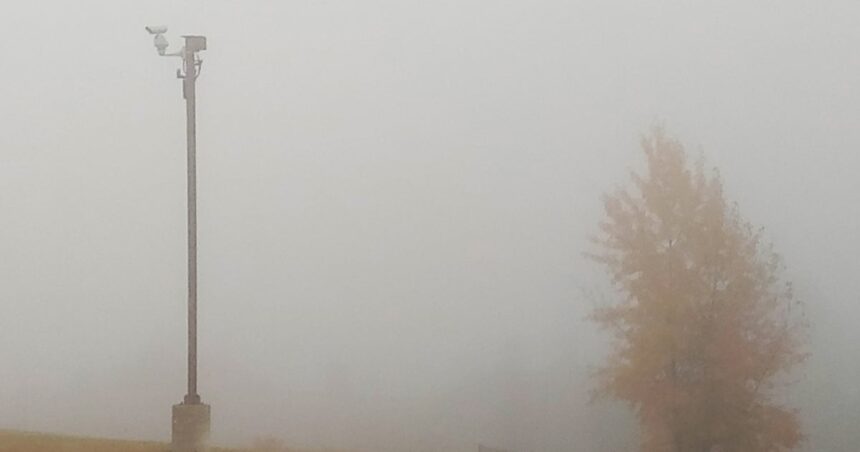

Sunday morning brought an unexpected blanket of thick fog across central Alberta. Drivers woke up to find streets nearly invisible under heavy gray clouds. The conditions stretched from Calgary north to Edmonton and beyond.
Environment and Climate Change Canada issued the fog advisory at 7:41 a.m. The federal weather agency labeled it a moderate risk. Officials warned that visibility had dropped to nearly zero in some areas. For anyone heading out early, the world outside looked like a wall of white.
I’ve covered weather events in Calgary for years now. This kind of dense fog isn’t uncommon during certain seasons. But it always catches people off guard. One minute you’re planning a normal Sunday drive. The next minute you can barely see the car ahead of you.
The fog hit Calgary particularly hard around 7 a.m. Residents reported struggling to see across their own neighborhoods. Street lights became faint glows in the mist. Traffic signals disappeared until drivers were right underneath them. Parks and pathways vanished completely from view.
But weather in Alberta changes fast. By 8 a.m., the fog started lifting in Calgary. Sunlight began breaking through the thick cover. The city slowly came back into focus. Visibility improved block by block as the morning progressed.
Edmonton faced similar conditions during the same timeframe. The advisory covered a wide swath of central Alberta between the two cities. Smaller communities along Highway 2 dealt with the same reduced visibility. Rural areas experienced some of the worst conditions.
Environment and Climate Change Canada predicted the fog would clear completely by late Sunday morning. The advisory remained in effect while pockets of heavy fog lingered. Some locations cleared faster than others. But officials warned that travel could still be dangerous in certain areas.
Fog advisories aren’t issued lightly by federal weather authorities. They come when visibility drops below specific thresholds. Moderate risk means drivers need to take real precautions. These aren’t just suggestions from overly cautious forecasters.
I remember covering a multi-vehicle pileup south of Calgary a few years back. Fog had reduced visibility to almost nothing. Drivers didn’t adjust their speed appropriately. The result was a chain reaction crash involving dozens of vehicles. Nobody wants to see that repeated.
The physics behind these fog events is actually pretty straightforward. When warm moist air meets cooler ground temperatures, condensation happens. Water droplets suspend in the air near the surface. If conditions are right, that creates the thick blanket we saw Sunday morning.
Central Alberta’s geography makes it particularly susceptible to fog formation. The relatively flat terrain between Calgary and Edmonton allows moisture to settle. River valleys and water bodies contribute additional moisture to the air. When temperature conditions align, fog develops quickly.
Sunday’s fog formed overnight as temperatures dropped. By early morning, it had reached peak density. The sun’s warmth eventually broke up the fog cover. As the day progressed and temperatures rose, the fog dissipated naturally.
Travel safety becomes critical during these advisories. Drivers need to slow down significantly when visibility drops. Using low beam headlights helps others see your vehicle. High beams actually make things worse by reflecting off the fog. Increasing following distance gives more reaction time.
Local emergency services stay on high alert during fog advisories. Police and fire departments prepare for potential accidents. Tow truck operators anticipate increased call volumes. Hospitals ready themselves for possible trauma cases.
Calgary’s road maintenance crews monitor conditions closely during weather events. They coordinate with provincial authorities on highway safety. Communication systems alert drivers to hazardous conditions. Electronic message boards display warnings along major routes.
The fog advisory system serves an important public safety function. Environment and Climate Change Canada monitors atmospheric conditions continuously. When dangerous weather develops, they issue timely alerts. These warnings reach the public through multiple channels including radio, television, and mobile apps.
Sunday’s advisory reflected the agency’s commitment to keeping Albertans informed. The moderate risk designation meant conditions were serious but manageable. People needed to exercise caution without panicking. Adjusting travel plans or delaying trips became reasonable options.
By mid-morning, the worst had passed. Calgary streets returned to normal visibility. Edmonton experienced similar clearing patterns. The fog advisory was eventually lifted as conditions improved across central Alberta.
Weather in this province keeps journalists like me busy. One day it’s fog advisories. The next day might bring sudden temperature swings or unexpected storms. Albertans have learned to stay adaptable and prepared.
This fog event reminded everyone that nature still controls our daily routines. Technology helps us predict and prepare for weather events. But we can’t prevent fog from forming or force it to clear faster. We can only adjust our behavior to stay safe.
Environment and Climate Change Canada continues monitoring atmospheric conditions across the province. Future advisories will be issued as needed. Albertans should stay informed about weather conditions, especially before traveling. Checking forecasts before heading out remains the smartest approach.
Sunday’s fog might have disrupted morning plans for some residents. But the quick clearing meant most people could get on with their day. By afternoon, the thick morning mist was just a memory.