
I was sitting in my Montreal apartment Sunday night when the news started filtering through social media. An Air Canada Express flight from our city had crashed at LaGuardia Airport. My heart sank immediately.
The flight carried 72 passengers and four crew members. It departed from Pierre Elliott Trudeau International Airport on what should have been a routine journey to New York City. Instead, it ended in devastating tragedy.
Two pilots lost their lives. Dozens of passengers suffered injuries. The entire aviation community is reeling.
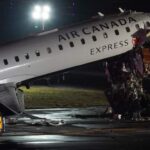
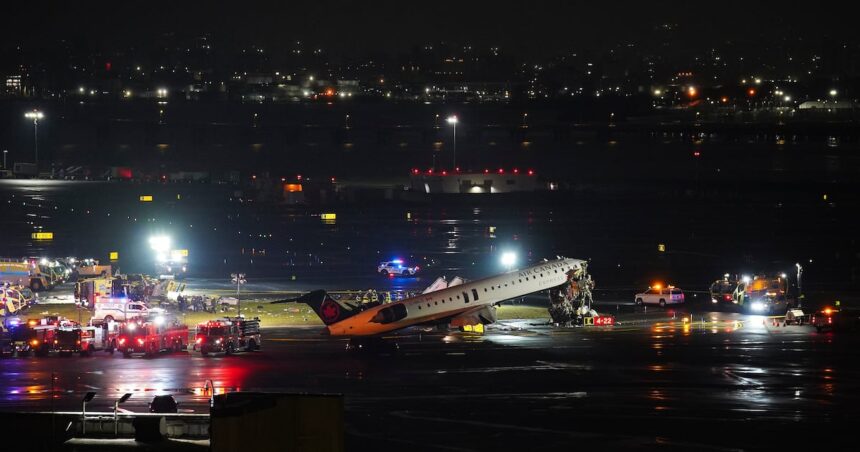
Air Canada confirmed the aircraft was operated by Jazz Aviation. The regional jet, a Bombardier CRJ900, collided with a fire truck after landing on the runway. The impact destroyed the cockpit completely.
Kathryn Garcia from the Port Authority of New York and New Jersey explained what happened. The fire truck was responding to a separate emergency involving a United Airlines flight. That aircraft had reported an odour issue during takeoff.
Some flight attendants on that plane felt ill. Controllers were mobilizing equipment to help evacuate passengers if needed. In the chaos, coordination broke down.
Air traffic control recordings tell a chilling story. One controller gave the fire truck clearance to cross the runway. Another controller had already cleared the Air Canada flight to land. The vehicles shouldn’t have been there together.
“Stop, Truck 1. Stop,” a voice urgently commands in the recording. But it was too late.
Aviation analyst Phyl Durdey spoke with CTV News about what likely happened. The aircraft was communicating on one frequency with the tower. The emergency vehicle was on a different frequency with ground control.
“This was a really bad tragedy, and it’s a big human error,” Durdey said plainly.
She explained that controllers handling the aircraft and the fire truck should have been communicating. That coordination prevents exactly this type of accident. By the time pilots saw the truck, stopping was impossible.
Passenger Jack Cabot described the moment of impact to CNN. He felt the plane “immediately hit something” after touching down. Chaos erupted instantly.
“Everyone was hunkered down and everyone was screaming,” Cabot recalled. The cockpit was destroyed, so no instructions came from the pilots. Passengers took action themselves.
Someone suggested rushing to the emergency exit. They opened the door and jumped out. That quick thinking likely saved lives.
The New York Post reported something extraordinary. A flight attendant survived after being ejected through the front of the aircraft. She remained strapped in her seat during the violent crash. Port Authority police rescued her and rushed her to hospital.
In total, 41 people went to two hospitals in Queens. By Monday morning, nine remained in care. Some faced serious injuries.
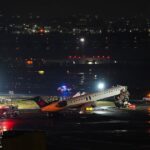
The aircraft’s nose pointed skyward in photos from the scene. The cockpit was peeled back to the first passenger window. Wires and flight controls hung in shredded tangles. Red emergency vehicles surrounded the wreckage under portable floodlights.
Montreal’s reaction came swiftly. Quebec Premier François Legault took to social media expressing deep sadness. “My thoughts are with the families of the deceased pilot and co-pilot,” he wrote.
Montreal Mayor Soraya Martinez Ferrada also shared condolences. She noted that U.S. and Canadian authorities were monitoring the situation closely.
Prime Minister Mark Carney called the crash “deeply saddening.” He confirmed Canadian officials were working with American counterparts. “My thoughts are with the victims, their families, and all those impacted,” Carney stated.
Foreign Affairs Minister Anita Anand confirmed consular officials contacted local authorities. They’re providing assistance to passengers. An additional team traveled to New York.
Air Canada established a helpline for families at 1-800-961-7099. The airline expressed profound sadness over losing two Jazz employees. They’re cooperating fully with investigators.
The Transportation Safety Board of Canada dispatched investigators to New York. They’re supporting the U.S. National Transportation Safety Board in the investigation. The TSB’s sole aim is advancing transportation safety, not assigning blame.
Aviation analyst John Cox outlined the investigation process. Investigators will examine air traffic control tapes thoroughly. They’ll analyze the flight data recorder and cockpit voice recorder. They’ll interview the fire truck driver and crew.
“It is a very methodical process to understand how this collision occurred,” Cox explained.
LaGuardia remained closed until at least 2 p.m. Monday. All flights between Montreal and LaGuardia were cancelled during that time. Toronto Pearson International Airport reported 26 cancelled flights due to the closure.
The airport typically handles about 45 flights daily between Pearson and LaGuardia. LaGuardia ranked as the 19th busiest U.S. airport in 2024. More than 16.7 million passengers boarded there.
Air traffic control recordings captured a heartbreaking exchange after the crash. One staffer tried consoling another. “That wasn’t good to watch,” someone said.
“I know. I tried to reach out,” came the reply. “We were dealing with an emergency earlier.”
“You did the best you could,” the first voice responded.
The Air Line Pilots Association called the loss a “profound tragedy.” Captain Jason Ambrosi, the association’s president, spoke for countless colleagues. “These pilots dedicated their careers to the safe transport of passengers,” he said.
New York City Mayor Zohran Mamdani thanked first responders for their swift actions. He credited them with saving lives. Transport Minister Steven MacKinnon emphasized that aviation safety remains Canada’s highest priority.
The Bombardier CRJ900 is a regional jet designed for short to medium routes. It carries between 50 and 100 passengers. The narrow-body aircraft features two engines mounted at the rear. Its distinctive T-shaped tail makes it recognizable.
As I write this, Montreal’s aviation community mourns. Two skilled professionals died doing jobs they loved. Dozens of passengers suffered trauma and injuries. Families face unimaginable grief.
This tragedy touches everyone who flies regularly between Montreal and New York. That route connects our cities daily. We trust pilots, controllers, and ground crews with our lives.
Something went terribly wrong Sunday night. Multiple systems failed simultaneously. Communication broke down at the worst possible moment. The investigation will determine exactly what happened.
For now, Montreal grieves alongside the families of those two pilots. We wait for answers. We hope the injured recover fully. We remember that aviation safety depends on thousands of people doing their jobs perfectly.
One mistake can cost everything.