
Walking through Toronto’s construction sites lately, I’ve noticed something troubling. Cranes that dominated our skyline just two years ago now sit idle. Projects that promised thousands of new homes have stalled. The math simply doesn’t work anymore for developers facing crushing upfront costs.
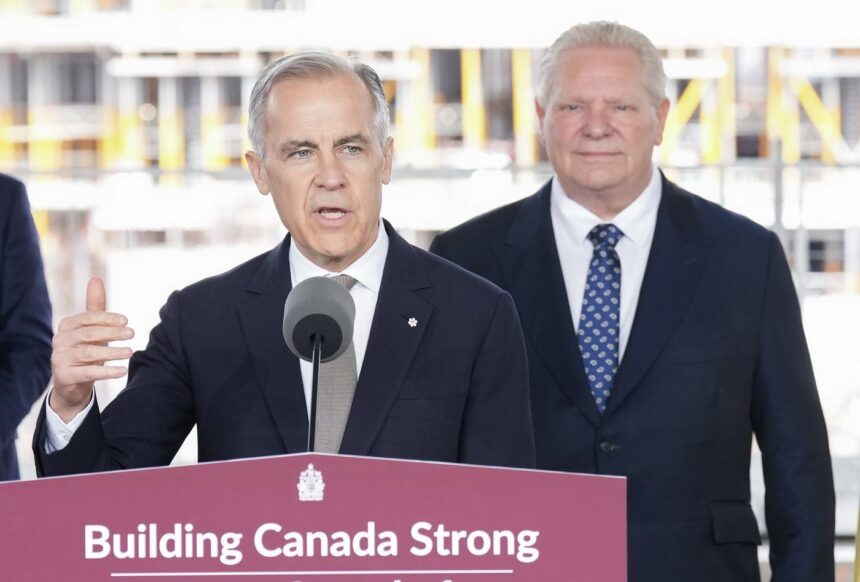
Monday brought news that might finally shift this equation. Prime Minister Mark Carney stood alongside Premier Doug Ford and Mayor Olivia Chow to announce an $8.8 billion infrastructure deal. The federal government and Ontario will each contribute $4.4 billion over the next decade. This represents the first major agreement through Ottawa’s new Build Communities Strong Fund.
The goal sounds straightforward enough. Cities that slash their development charges by up to fifty percent for three years will receive funding. Those that refuse won’t see a single dollar. Ford made this crystal clear during the announcement.
“If you don’t cut DCs, you aren’t getting any money,” the Premier stated bluntly. “But if you do, we will be there to support you.”
Development charges represent fees that cities impose on builders. These costs typically fund infrastructure that new housing requires. Transit lines, water systems, and sewer networks all demand significant investment. Over recent years, these charges have ballooned dramatically across Ontario.
David Amborski directs the Centre for Urban Research and Land Development at Toronto Metropolitan University. He explained to reporters how municipalities grew dependent on development charges. Property tax increases anger existing residents. Development charges, however, function as hidden taxes that fall on future homeowners instead.
“If you have development charges, it’s more of a hidden, indirect tax,” Amborski noted. “To some degree, it’s imposed on people who may not even live in the jurisdiction yet.”
I’ve covered Toronto’s housing crisis for years now. This political calculation has created a vicious cycle. Cities avoid raising property taxes by loading costs onto new construction. Builders pass these expenses to buyers. Home prices climb higher. Young families get priced out of neighborhoods their parents could afford.
The new funding framework targets high-growth municipalities where housing shortages hurt most. Cities must submit project lists for federal and provincial review. Municipalities committing to thirty to fifty percent development charge cuts will receive priority consideration. The ten-year timeline spreads infrastructure costs across multiple budget cycles.
Last week brought additional relief measures. Ontario and Ottawa announced they would waive harmonized sales tax on eligible new builds for twelve months. Combined with development charge reductions, governments estimate savings of up to $200,000 per new home.
Both Carney and Ford have staked political capital on ramping up housing supply. National housing starts rose 5.6 percent annually in 2025 according to Canada Mortgage and Housing Corporation. Ontario actually saw declines during this same period.
CMHC released updated forecasts last month that paint a concerning picture. The agency expects national construction rates to fall for three consecutive years. High construction costs and weak buyer demand create substantial headwinds. Ontario faces particular challenges given development charges that rank among Canada’s highest.
Conservative Leader Pierre Poilievre took to social media Monday to criticize the announcement. He argued Canada needs “results not rhetoric” given slowing construction forecasts. Poilievre claimed credit for originally suggesting lower development charges and reduced housing taxes.
The Ontario Home Builders’ Association issued a statement praising the federal-provincial partnership as “historic.” The industry group believes reduced development charges will improve project viability while enhancing affordability for buyers.
Carney expressed confidence that market competition will force developers to pass savings along to homebuyers. I’m less certain this assumption holds up under scrutiny.
Amborski shared my skepticism during our conversation Monday afternoon. Whether developers actually reduce prices depends entirely on market conditions when policies take effect. Hot markets with rising prices let builders pocket input cost savings without losing customers.
“If developers could charge $10,000 more because the market’s going up, they’re not going to reduce the cost,” Amborski explained. “They’re going to take a $10,000 profit.”
Current conditions might actually favor buyers for once. Prices are falling across many Canadian resale markets right now. Reduced upfront costs could convince developers that modest profits on competitively priced units beat no profits on stalled projects.
Walking through Liberty Village last week, I spoke with several condo buyers who’ve watched their deposits sit frozen in incomplete projects. These folks aren’t looking for luxury finishes or premium locations anymore. They just want functional homes at prices that won’t bankrupt them.
Amborski raised questions about whether $8.8 billion will actually prove sufficient to cut development charges in half. He emphasized that no single policy will solve housing affordability alone. Multiple interventions working together might gradually bend the cost curve downward.
“Bottom line is, it’s got to help,” Amborski told me. “It’s got to help reducing the cost of housing.”
This announcement follows Ottawa’s recent commitment of $1.7 billion for provinces and territories to boost housing supply through locally determined means. Finance Minister François-Philippe Champagne cited declining home prices and the urgent need to restart stalled construction.
Toronto desperately needs this intervention to succeed. Our city has become a cautionary tale of what happens when housing costs spiral beyond ordinary people’s reach. Teachers, nurses, and service workers who keep our community functioning can’t afford to live here anymore.
I remain cautiously hopeful that coordinated federal and provincial action might finally address systemic cost barriers. The proof will come when cranes start moving again and shovels break ground on projects that currently sit frozen. Until then, thousands of Toronto families wait for homes that exist only on paper.