
The spring air in Edmonton carries something heavier than usual this week. It’s the weight of a $20-billion question hanging over Alberta’s political landscape.
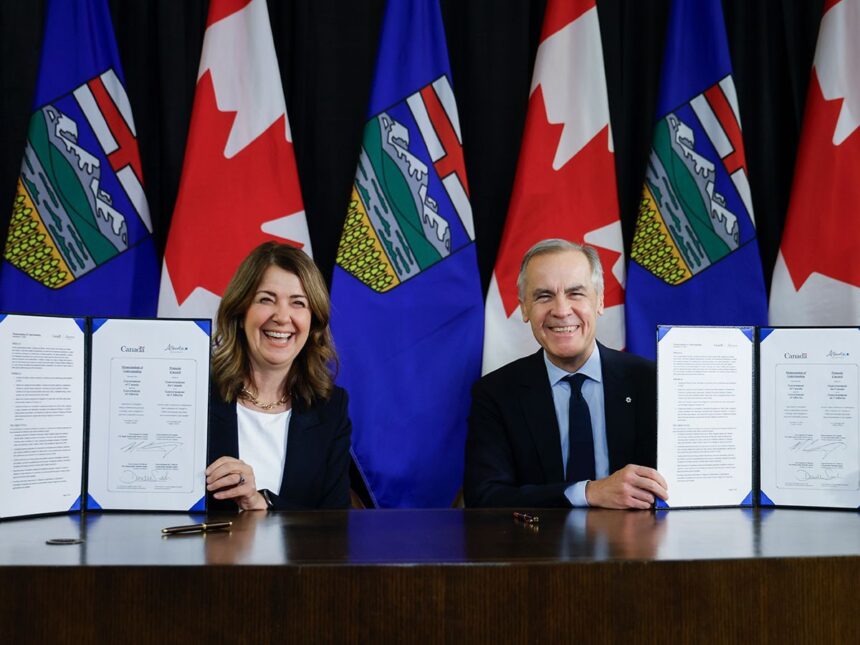
Premier Danielle Smith and Prime Minister Mark Carney have been working toward something big. They call it an energy “grand bargain.” The two leaders signed a preliminary agreement back in November. They promised Albertans a final deal by April 1. That deadline is now breathing down their necks.
This isn’t just another political handshake. Many observers see it as the most important attempt in decades to repair the broken relationship between Alberta’s energy sector and the federal government. For oil and gas workers across our province, it represents hope for expanded production and new pipelines.
But there’s a catch. A massive one.
The deal hinges partly on building something called the Pathways carbon capture network. This proposed system would collect carbon dioxide from up to 13 oilsands facilities near Fort McMurray. Then it would pipe that CO2 roughly 400 kilometres south to Cold Lake. There, the emissions would get pumped deep underground into rock formations.
The scale is breathtaking. We’re talking about capturing 12 million tonnes of carbon dioxide every single year. Nothing like this exists anywhere else in the world.
I’ve covered Edmonton’s energy scene for years now. I’ve watched countless projects get announced with fanfare only to quietly disappear. This one feels different because of the sheer numbers involved.
The price tag keeps climbing. Initial estimates put construction costs around $16 billion. Now the Oil Sands Alliance, the industry group behind Pathways, says it’ll cost $20 billion or more. That’s billion with a B.
Here’s where it gets uncomfortable for taxpayers. The oilsands companies say they can’t shoulder this burden alone. They want governments to cover 75 percent of construction costs. That means Ottawa and Alberta would need to pony up roughly $15 billion in public money.
Keith McLaughlin works as a partner at New West Public Affairs in Calgary. He’s been following this saga closely. “The scale of this is much, much larger than anything that’s been proposed in any other jurisdiction,” he told reporters recently.
Smith acknowledged last week that Wednesday’s deadline probably won’t be met. She’s hoping for a final agreement within weeks. Carney confirmed on Tuesday afternoon that expectations should be tempered.
The premier faces real political pressure here. Some voters wonder why she’s negotiating with Ottawa at all. Others within her own caucus question whether engaging with the feds will produce anything worthwhile. Smith needs to prove this approach can deliver results.
“There’s a lot of political benefit here for the premier,” McLaughlin explained. “They’ve put a lot on the line here, for sure, but they’re confident they’re going to be able to get it done.”
The stakes extend beyond just Pathways itself. Smith wants a new oil pipeline to the West Coast. Carney has expressed support for that idea. But the memorandum of understanding includes specific language. It states that getting Pathways into its first development phase is a “precondition” before any new bitumen pipeline gets approved.
No Pathways progress? No pipeline. It’s that simple.
The oilsands companies themselves seem surprisingly unenthusiastic. They’ve repeatedly pointed out that carbon capture adds costs without adding competitiveness. Other oil-producing countries don’t face these requirements. Carbon dioxide has essentially no market value right now. Companies can’t make money from the CO2 they capture and store.
In February, the industry group made a telling change. They dropped the “Pathways Alliance” name. Now they call themselves the “Oil Sands Alliance.” The rebranding suggests shifting priorities.
The alliance didn’t answer direct questions from reporters. They issued a general statement saying Pathways would help make Canada a “global supplier of choice to meet forecasted ongoing oil demand.” The language felt carefully chosen and notably restrained.
Pathways emerged in 2021 during the Trudeau years. Back then, federal environmental regulations were tightening. Carbon taxes were rising. An emissions cap on oilsands production was being discussed. Carbon capture seemed like a way to expand production while still cutting emissions.
The world has changed since then. Heather Exner-Pirot serves as special adviser to the Business Council of Canada. She’s watched the political winds shift dramatically.
“Pathways was created at a time when climate policy was an existential threat,” she said. “And now, it’s obviously not a topline issue for voters. Now, it’s very much: build, expand, produce more, be an energy superpower.”
That shift creates an awkward situation. The industry proposed Pathways when environmental pressure was intense. Now that pressure has eased somewhat. Yet they’re still asking for billions in taxpayer support for a project designed to address yesterday’s political climate.
Exner-Pirot points out another uncomfortable truth. The project lacks an obvious constituency among voters who’d ultimately pay for it.
“Who is the demographic that wants that?” she asked. “On the right, they won’t be impressed with the $20 billion government spending on carbon capture. And on the left, they also think it’s a waste of money because it supports fossil fuel production.”
I’ve had coffee with Edmontonians across the political spectrum lately. That assessment rings true. Conservative friends bristle at massive government spending. Progressive friends question subsidizing fossil fuel infrastructure. Finding enthusiastic supporters requires real effort.
Both levels of government have already committed significant support. Ottawa offers tax credits covering up to 50 percent of eligible capital costs. Alberta adds another 12 percent tax credit. Together, that’s 62 percent of construction expenses potentially covered by public funds.
The oilsands industry says it’s not enough. They’re still pushing for that 75 percent threshold.
Beyond construction costs, there’s the question of ongoing operations. Carbon capture facilities need financial support after they’re built too. Ottawa has created something called “carbon contracts for difference.” These government-backed guarantees ensure companies receive a set price for every tonne of CO2 they store underground.
The federal government has already set aside $7 billion for these contracts through the Canada Growth Fund. Industry observers say billions more will be needed to cover operating losses over the long term.
Walking through downtown Edmonton these past weeks, I’ve noticed the mood shifting. People are paying attention to this deal in ways they usually don’t with federal-provincial negotiations. Energy remains central to our provincial identity. What happens with this agreement will shape Alberta’s economic future for decades.
The April 1 deadline is essentially missed now. Smith and Carney are buying time with talk of finalizing details “in the next few weeks.” Whether those weeks turn into months or the deal falls apart entirely remains unclear.
What is clear is that Albertans deserve straight answers about what this project will cost and who will pay. Twenty billion dollars is real money. Asking taxpayers to cover most of that tab for private sector emissions reduction deserves serious public debate.
The grand bargain might still come together. Smith clearly believes it’s worth pursuing. But the massive financial burden of Pathways casts a long shadow over everything. That shadow extends well beyond the Premier’s office in Edmonton, reaching into the wallets of every Canadian taxpayer.