
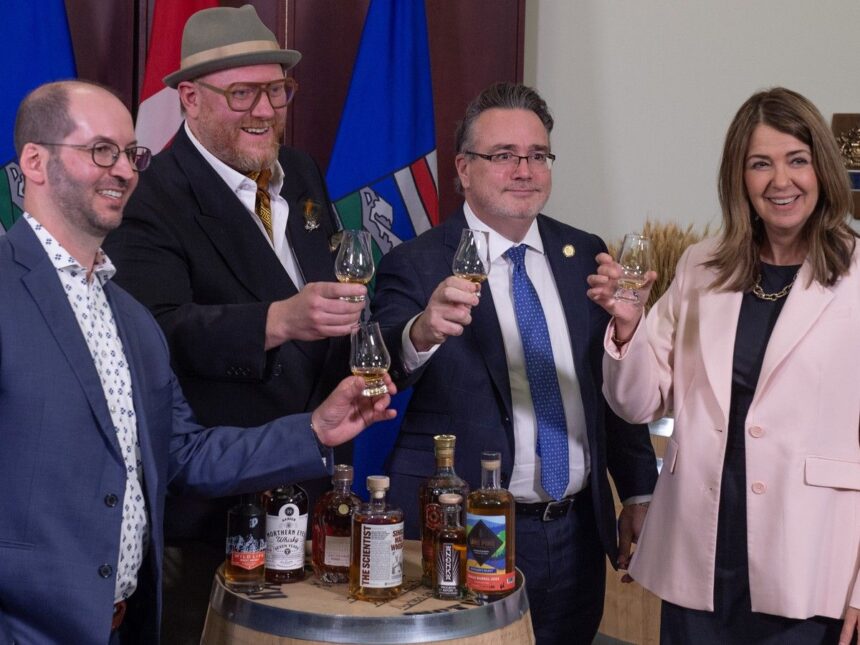

I’ve been following Edmonton’s craft distilling scene since those first tiny operations started popping up around the city more than a decade ago. Walking into those early tasting rooms felt like discovering hidden treasures tucked away in industrial parks and repurposed warehouses. Now, our provincial government wants to give Alberta’s whisky the same prestigious recognition that Champagne and Scotch enjoy worldwide.
The Alberta Whisky Act landed in the legislature this week. It’s designed to set clear standards for what qualifies as genuine Alberta whisky. Minister Dale Nally didn’t mince words when he announced the legislation. He called Alberta whisky one of the best-kept secrets in the whisky world and promised that’s about to change.
I’ve spent considerable time in local distilleries interviewing makers and tasting their creations. The passion these producers bring to their craft is remarkable. They’re working with prairie grains and Rocky Mountain water to create something distinctly ours. But they’ve struggled to stand out in a crowded Canadian whisky market.
Premier Danielle Smith explained that the government consulted directly with producers. Small-batch distilleries have only been legal here since 2013. That makes this an incredibly young industry still finding its feet. The consistent feedback was clear: Alberta distillers make exceptional whisky but need help differentiating their products from generic Canadian offerings.
The new act establishes specific requirements for the Alberta whisky designation. First, producers must follow global standards that apply to all whisky. The spirit needs at least three years of aging in wooden barrels. It must contain a minimum of 40 percent alcohol by volume. Those are the baseline rules recognized everywhere.
But the Alberta-specific requirements go further. All water used must come from Alberta sources. At least two-thirds of the grain must be grown in this province. The whisky must be mashed, fermented, aged and bottled entirely within Alberta’s borders. Producers can add up to nine percent outside spirits for flavouring, but those additions require at least two years of aging.
One detail that caught my attention was the spelling requirement. The legislation calls for “whisky” without the extra e. However, distillers already using “whiskey” in their branding won’t face penalties. It’s a flexible approach that respects existing business decisions while establishing a provincial standard.
I spoke with Bryce Parsons recently at his Calgary operation, True Wild Distilling. He serves as president of the Alberta Craft Distillers Association. Parsons sees this legislation as an accelerant for the industry’s next growth phase. He connected it directly to our expanding tourism sector, noting that distinctive regional recognition brings curious visitors to tasting rooms.
Walking through distilleries around Edmonton, you notice the meticulous attention to detail. Copper stills gleam under industrial lighting. Barrels rest in temperature-controlled rooms. The air carries sweet, complex aromas that change with each production batch. These aren’t mass-market operations churning out generic products.
Current statistics from Alberta Gaming, Liquor and Cannabis show 45 distilleries producing whisky across the province. Of those, 43 qualify as small-batch producers. That’s a significant number for such a young industry. Drive through neighbourhoods around Edmonton and you’ll find several of these operations within easy reach.
Not everyone in the industry celebrates this legislation equally. Richard Bogach owns White Lightning Distillery in Barrhead, northwest of Edmonton. He told reporters the act merely entrenches practices most whisky makers already follow. Bogach called it old news and suggested we’re five years behind the times.
His critique raises valid questions about the two-thirds Alberta grain requirement. Bogach asked why the standard isn’t set at 100 percent. It’s a fair point worth considering. If we’re creating a premium regional designation, shouldn’t it demand complete commitment to local ingredients?
I’ve tasted whiskies made entirely from Alberta grain. The terroir comes through distinctly. Our prairie-grown barley and rye carry flavours shaped by intense summer sun and cold winter dormancy. When you compare them to spirits made with imported grain, differences emerge clearly.
The government looked to established whisky regions for guidance. Ireland, Scotland and Kentucky’s bourbon country all use strong regional definitions. Those designations built consumer trust and international recognition over generations. Alberta hopes to accelerate that process through legislation rather than waiting decades for organic market development.
An unexpected element of this legislation involves artificial intelligence. This marks the first bill tabled in our legislature created with AI assistance. Minister Nally emphasized that humans handled the final product and editing, but acknowledged AI played a supporting role. He compared Alberta’s current AI proficiency to being on page 10 of a 200-page novel.
That admission sparked immediate debate. Some praised the government’s innovative approach to streamlining legislative drafting. Others expressed concern about appropriate boundaries for AI in lawmaking. It’s a conversation we’ll be having much more frequently in coming years.
For Edmonton’s distilling community, this legislation represents validation. I’ve watched these entrepreneurs pour resources and creativity into building something meaningful. They’ve competed against established brands with far deeper pockets and longer histories. This provincial designation gives them a marketing tool that could level the playing field.
Whether the Alberta Whisky Act delivers its promised boost remains to be seen. International recognition doesn’t happen overnight, even with legislative backing. But I’m optimistic about our local producers’ chances. They’ve already proven they can make world-class spirits. Now they have government support to tell that story more effectively.
Next time you’re shopping for whisky, look for that Alberta designation. Visit a local distillery tasting room and meet the makers behind the bottles. Their stories are as rich and complex as the spirits they’re crafting.