
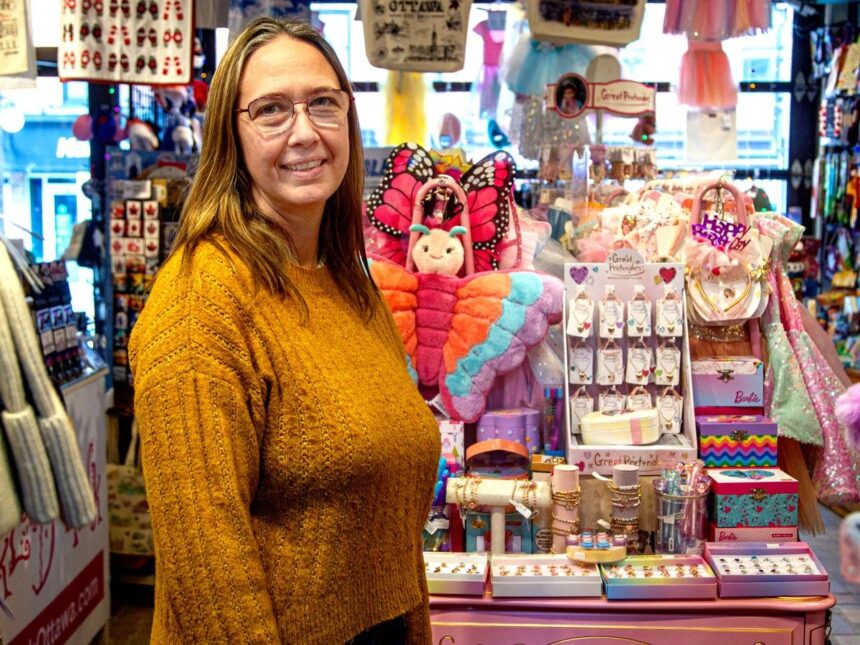

Jill Anguaya isn’t celebrating Ottawa’s ambitious plans for the ByWard Market building. The owner of Tickled Pink sits inside her gift shop at 55 ByWard Market Square, surrounded by toys and crafts. She’s been here since 2012, but her business has served this community for over three decades.
Her worry is simple and heartbreaking. Where does a shop like hers fit into the city’s vision?
I’ve walked through that market building countless times over the years. Each visit brings something different—a handmade doll, imported textiles, the smell of fresh bread. It’s messy, unpredictable, and wonderfully human. That’s precisely what makes it special.
The City of Ottawa recently approved a roughly $40-million redevelopment strategy for the historic market hall. Council members envision transforming the century-old building into what they call a “curated food-focused destination.” The architectural renderings show bright, open spaces with rotating food vendors and modern aesthetics.
It looks stunning on paper. It also looks like a food court.
The ByWard Market Action Plan suggests the current building isn’t reaching its “highest and best potential.” City planners propose specialty grocers, bakeries, two full-service restaurants upstairs, and rotating vendor stalls. The Business and Tenant Support Strategy report acknowledges that some existing businesses will need to “permanently relocate or cease operations.”
That’s bureaucratic language for goodbye.
Jill’s husband Jacinto runs Quichua World Market in the same building. They sell crafts, textiles, and jewelry—items you can’t find at a typical food court. They’ve built their lives here. They’ve employed Ottawa residents. They’ve weathered slow seasons and economic downturns.
The city’s relocation assistance feels hollow to many tenants. Officials promise “relocation advisory support” and potential help finding space “within defined radii.” When government documents start talking about defined radii, business owners know they’re essentially on their own.
I count nine food vendors already operating inside the market building. Walk outside those doors and you’ll find dozens more restaurants, coffee shops, and cafés throughout the ByWard district. Ottawa doesn’t lack places to eat in this neighborhood.
What we might lose, however, are the quirky shops that give the market its character.
The city identified $5.7 million in immediate building repairs in 2023. Another $6.5 million will be needed for upgrades over the next twenty years. Nobody disputes that the structure needs work. Crumbling infrastructure serves neither tenants nor visitors.
But fixing a roof is different from deciding who belongs underneath it.
Even established food businesses face uncertainty under the proposed plan. Le Moulin de Provence gained international fame when Barack Obama stopped in for a cookie during his 2009 presidential visit. The bakery currently uses second-floor space for production—space that renderings appear to allocate for new restaurants.
If Le Moulin de Provence struggles to fit the blueprint, what hope exists for gift shops?
The last major renovation happened in the late 1990s. Tenants who wanted to return after construction were guaranteed their spots. That promise isn’t being made this time. The difference speaks volumes about how city officials view the current tenant mix.
Council recently approved millions for design work, including $2.7 million specifically for 55 ByWard Market Square. The final configuration isn’t settled yet. But the direction seems clear.
Public markets historically served as community gathering places. People came to buy vegetables, yes, but also to browse handmade goods, discover unusual imports, and encounter the unexpected. Markets thrived on diversity—not just of food, but of merchandise and human experience.
Shops like Tickled Pink, Canada in a Basket, and Adaawewigamig represent that broader market tradition. They’re not trendy or Instagram-worthy. They’re spaces where someone might find a perfect gift or stumble upon something they didn’t know they wanted.
These businesses have survived tough years in the ByWard Market. They’ve endured construction disruptions, economic recessions, and shifting consumer habits. They’ve provided employment for families across Ottawa. They’ve paid rent even when foot traffic disappeared.
The city wants more seating where people can relax without buying full meals. That’s a reasonable goal. But Ottawa could create public seating areas without displacing established businesses. Imagination shouldn’t require eviction.
Food courts exist everywhere. Every shopping mall offers the same basic formula—multiple vendors, shared seating, consistent aesthetics. They’re convenient and predictable. They’re also interchangeable and forgettable.
The ByWard Market’s appeal has always come from its imperfect authenticity. You might find exceptional Vietnamese food next to a costume shop next to a Venezuelan café. The randomness creates discovery. The lack of curation makes each visit feel different.
Modern redevelopment projects often prioritize clean lines and unified visions. Architects and planners dream of cohesive spaces where everything matches. Those dreams rarely include dusty gift shops selling toys alongside imported jewelry.
I understand the impulse. Messy feels outdated. Curated feels professional. But sterile efficiency often kills the very charm that made a place worth visiting.
Walking through those renderings, I see beautiful spaces. I also see emptiness—not physical emptiness, but the absence of personality. The proposed market looks like it could exist anywhere. It doesn’t look like Ottawa.
Jill Anguaya’s question deserves a better answer than vague promises about relocation advisors. She’s asking whether the city values businesses like hers. She’s asking whether decades of service to this community count for anything.
The city might deliver a shinier building. The halls might look brighter in photographs. Tour buses might still stop at the ByWard Market.
But Ottawa risks losing something irreplaceable—the independent businesses that made this market feel alive. We might gain efficiency while sacrificing character. We might get modern amenities while losing our history.
That trade-off deserves more public discussion before construction begins. Because once Tickled Pink closes its doors, no amount of architectural brilliance will bring it back.
Our website keeps you informed on Ottawa’s most pressing community issues, so bookmark our homepage and sign up for newsletters.