

I’ve watched this city rebuild itself after 2013, and what’s happening in Roxboro right now tells me something fundamental has shifted in how Calgarians view risk and opportunity.
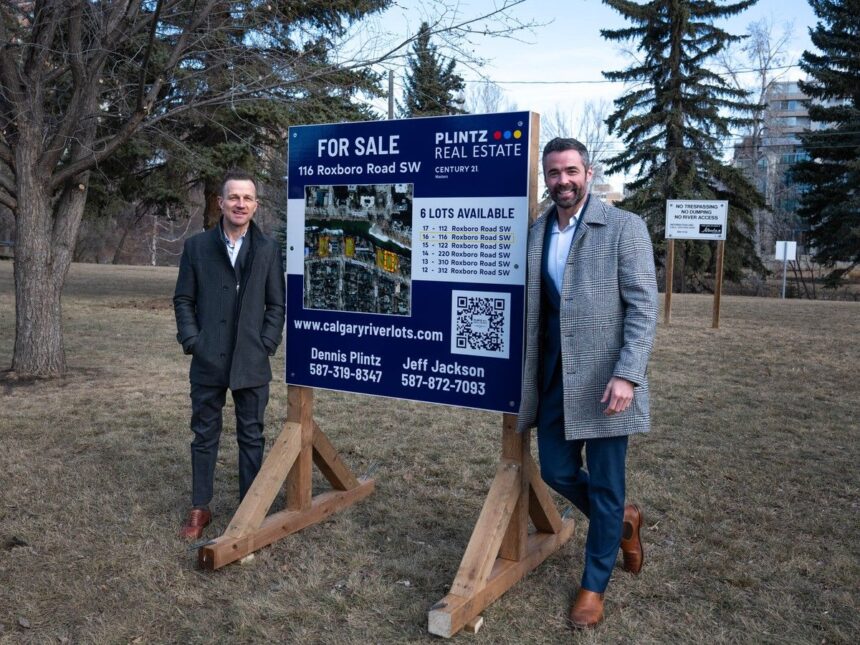
Six government-owned lots along the Elbow River are officially up for sale. These aren’t just any properties. They’re remnants of Alberta’s most expensive natural disaster, pieces of land where families once lived before floodwaters rewrote the rules. Now they’re being positioned as premium real estate, with price tags reaching $3 million.
The provincial government spent over $100 million acquiring roughly 80 homes across Alberta after the 2013 floods devastated communities. Seventeen of those purchases happened right here in Calgary, concentrated in Elbow Park, Rideau Park, and Roxboro. These weren’t voluntary sales in most cases. Homeowners faced impossible choices between rebuilding in high-risk zones or accepting buyouts and starting fresh elsewhere.
By 2015, the homes on these Roxboro lots were demolished. What remained were empty riverside parcels, officially designated as floodway land where residential development was prohibited. For nearly a decade, they sat vacant while the province debated what to do with them.
Then upstream mitigation changed everything. The Springbank Off-Stream Reservoir project fundamentally altered flood risk calculations for communities along the Elbow River. According to Dennis Plintz, an associate broker with Plintz Real Estate handling the listings, that infrastructure investment restored confidence in riverfront development.
“With Springbank in place, confidence has been restored,” Plintz told reporters. “And for residents of the community, it’s been a long anticipated and exciting journey, with a lot of nervousness around it.”
I’ve covered enough city council meetings to know that nervousness runs deep. Roxboro residents have lived with uncertainty for over a decade. They’ve watched their neighborhood shrink, seen property values fluctuate wildly, and endured constant questions about whether riverfront living was still viable in Calgary.
Infrastructure Minister Martin Long announced last year that the province would sell these Calgary properties through a market-based approach. That decision raised eyebrows among some flood survivors who questioned whether the government should profit from disaster buyouts. Others saw it as pragmatic management of public assets.
Plintz Real Estate, operating under Century 21, won the listing contract after the province issued requests for proposals to 8,000 real estate groups. Their pitch emphasized strategy, local experience, and deep knowledge of Calgary’s market dynamics.
Jeff Jackson, another associate broker on the team, explained their mandate clearly. Maximize value for taxpayers while ensuring fair access for potential buyers. It’s a delicate balance that required careful planning.
“We actually put forward a few different options to the province when we proposed our plan for marketing these opportunities,” Jackson said. “And the one that the province selected is a traditional MLS process. So these lots are ready to be listed.”
The pricing reflects current market realities and the unique appeal of riverfront property. Lots range from $1.75 million to $3 million, based on comparable sales data and frontage dimensions. All six properties are zoned for single-family residences, with restrictive covenants and standard building codes applying.
Plintz emphasized that extensive pre-marketing research indicated strong demand. Calgary’s riverfront inventory remains extremely limited, especially for buildable lots in established inner-city communities. Roxboro offers proximity to downtown, mature tree canopy, and direct river access that’s increasingly rare.
“The price range on these lots ranges from $1,750,000 to $3 million,” Plintz noted. “We spent a lot of time determining market value based on comparables.”
The properties vary in size and configuration. Some are individual lots with 50 feet of frontage. Others sit side-by-side, offering potential buyers 100 feet of continuous river access. That flexibility should appeal to different buyer profiles, from custom home builders to families seeking specific lot characteristics.
The sales process includes deliberate safeguards. When listings go live, a mandatory two-week advertising period begins. During that time, the province won’t review any offers. It’s designed to prevent insider advantages and ensure equal opportunity for interested buyers.
After the advertising period closes, offers will be reviewed on a rolling basis. Unsuccessful bidders on one property can redirect their interest toward remaining lots. It’s a structured approach that should prevent the feeding frenzy that sometimes characterizes high-demand real estate sales.
Jackson believes these initial six properties will establish pricing benchmarks for Calgary’s riverfront market going forward. “These six, we certainly feel are going to set the stage and set the market value for Calgary riverfront,” he said.
What happens to the remaining eleven provincially-owned properties remains unclear. Jackson acknowledged uncertainty about timing but expressed confidence they’ll eventually reach the market. The province appears to be testing demand and pricing dynamics before committing to a comprehensive disposition strategy.
This sale represents more than real estate transactions. It’s a referendum on whether Calgary has genuinely moved past 2013’s trauma. Are buyers willing to invest millions in riverfront property despite living memory of catastrophic flooding? Does infrastructure mitigation provide sufficient psychological comfort to rebuild in previously devastated areas?
I think the answer depends partly on generation and risk tolerance. Younger buyers without direct flood experience may view these lots as premium opportunities in desirable locations. Older Calgarians who remember sandbagging efforts and evacuation orders might remain skeptical regardless of engineering assurances.
The economic implications extend beyond individual sales. Successful disposition of these properties would return them to the tax base, generate construction employment, and signal confidence in inner-city riverfront development. Failure to attract buyers at asking prices would raise uncomfortable questions about long-term viability of flood-prone neighborhoods.
Roxboro residents are watching closely. New construction on vacant lots would bring neighbors, activity, and renewed investment to their community. Continued vacancy would reinforce perceptions of decline and risk.
The provincial government faces its own calculations. Recovering a portion of the $100 million spent on buyouts would demonstrate fiscal responsibility. But accepting significantly reduced prices might suggest the land remains fundamentally devalued by flood history.
Calgary’s riverfront real estate has always carried premium status. These Roxboro lots test whether that premium survives disaster, government intervention, and infrastructure promises. The market will deliver its verdict soon enough.