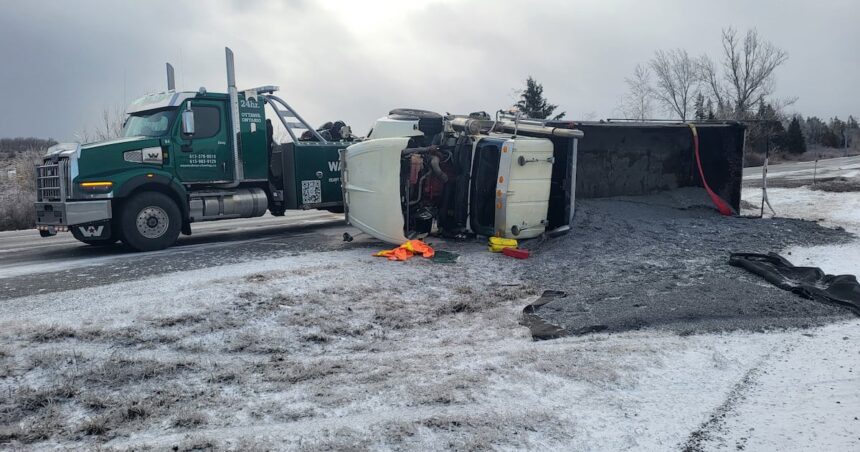

The treacherous winter roads we’ve all learned to navigate in Eastern Ontario claimed two commercial trucks this past week, reminding everyone just how unforgiving our highways become when ice takes control. Both incidents occurred within hours of each other, creating significant traffic disruptions and highlighting the ongoing battle between commerce and Mother Nature’s unpredictable temperament.
According to the Ontario Provincial Police, the first rollover happened early Thursday morning along Highway 417 near Casselman. The transport truck lost control on a patch of black ice that had formed overnight. The driver sustained minor injuries but was transported to hospital as a precautionary measure. Emergency responders closed the eastbound lanes for nearly four hours while crews worked to clear the overturned vehicle and its scattered cargo.
The second incident unfolded just before noon on Highway 7 between Carleton Place and Perth. Another commercial truck encountered similar icy conditions and rolled onto its side. Fortunately, the driver walked away with only minor bruises. Local fire departments and towing services spent the better part of the afternoon righting the massive vehicle and reopening the highway to normal traffic flow.
I’ve covered winter accidents in this region for over two decades now. Every year brings the same pattern of surprise when that first serious cold snap arrives. Drivers seem to forget the lessons learned during previous winters. Commercial operators face immense pressure to maintain delivery schedules regardless of weather conditions, creating a dangerous equation on roads that transform from safe to hazardous within minutes.
The Ontario Provincial Police issued statements urging all drivers to exercise extreme caution during the current cold weather pattern. Sergeant Marie Bouchard emphasized that commercial vehicle operators must adjust their driving habits significantly when temperatures hover near freezing. “Black ice is virtually invisible,” she explained during a press briefing Thursday afternoon. “By the time drivers realize they’ve hit a patch, it’s often too late to regain control safely.”
Weather data from Environment Canada showed temperatures fluctuating between minus two and plus one degrees Celsius throughout Wednesday night and Thursday morning. These conditions create the perfect environment for black ice formation, particularly on bridge surfaces and shaded portions of highways. Moisture from earlier precipitation freezes rapidly, creating a nearly invisible hazard that catches even experienced drivers off guard.
The Ministry of Transportation deployed additional road maintenance crews throughout Eastern Ontario following these incidents. Salt trucks and plows increased their coverage patterns, focusing particularly on known trouble spots along major commercial routes. MTO spokesperson David Chen confirmed that crews have been working around the clock to keep highways safe and passable during this challenging weather period.
Local trucking companies have also responded by implementing additional safety protocols. Gilles Normandin, fleet manager for a Hawkesbury-based transport company, told reporters his organization now requires drivers to reduce speeds by at least twenty kilometers per hour when conditions deteriorate. “No delivery deadline is worth risking lives or equipment,” Normandin stated firmly. “We’ve instructed our drivers to pull over and wait if conditions become too dangerous.”
The economic impact of these rollovers extends beyond immediate cleanup costs. Highway closures disrupt supply chains that businesses throughout the region depend upon. Fresh produce, manufacturing components, and consumer goods all travel these routes daily. When major arteries close for extended periods, the ripple effects touch retailers, manufacturers, and ultimately consumers who notice delayed deliveries or empty store shelves.
Insurance industry representatives point out that rollover accidents involving commercial vehicles typically result in claims exceeding one hundred thousand dollars. Beyond the vehicle damage itself, cargo losses, environmental cleanup from spilled fuel or other materials, and liability considerations create substantial financial consequences. These costs ultimately filter through the entire economy in the form of higher insurance premiums and transportation expenses.
Community members living near Highway 417 and Highway 7 have grown accustomed to the sounds of emergency vehicles responding to winter accidents. Sharon MacDonald, who lives just off Highway 7 near Perth, described hearing the collision Thursday morning. “I knew immediately what had happened,” she recounted. “That horrible screeching sound of metal, then the crash. I’ve lived here thirty years and heard it too many times.”
The Canadian Trucking Alliance recently released safety recommendations specifically addressing winter driving conditions. Their guidelines emphasize pre-trip vehicle inspections, tire condition monitoring, and realistic trip planning that accounts for weather delays. Alliance spokesperson Jennifer Wu stressed that professional drivers must feel empowered to refuse unsafe assignments without fearing employment consequences.
Provincial transportation officials continue monitoring road conditions throughout Eastern Ontario as the winter season intensifies. Additional freezing rain and snow remain in the forecast for coming weeks. The combination of commercial traffic volume and unpredictable weather patterns creates ongoing challenges for everyone sharing these highways.
As someone who drives these same routes regularly while covering stories across the region, I understand the anxiety that accompanies winter travel. Every trip requires heightened awareness and constant vigilance. The familiar highways we navigate confidently during summer months transform into obstacle courses requiring respect and caution once ice arrives.
Both truck drivers involved in this week’s rollovers were experienced professionals with clean driving records. Their mishaps underscore an important reality: winter road conditions can overwhelm even the most skilled operators. No amount of experience guarantees safety when black ice eliminates tire traction in an instant.
Emergency responders deserve recognition for their quick, professional response to both incidents. Police officers, firefighters, paramedics, and tow truck operators all worked efficiently despite challenging conditions. Their coordinated efforts minimized traffic disruption and ensured both drivers received appropriate medical attention.
Looking ahead, transportation experts predict climate change will create increasingly unpredictable winter weather patterns. Temperature fluctuations that promote black ice formation may become more frequent. This reality demands continued investment in road maintenance infrastructure and ongoing driver education initiatives.
The message remains clear for everyone traveling Eastern Ontario highways this winter: slow down, increase following distances, and never underestimate how quickly conditions can deteriorate. Those two overturned trucks serve as expensive, dramatic reminders that winter demands our complete respect and attention.