
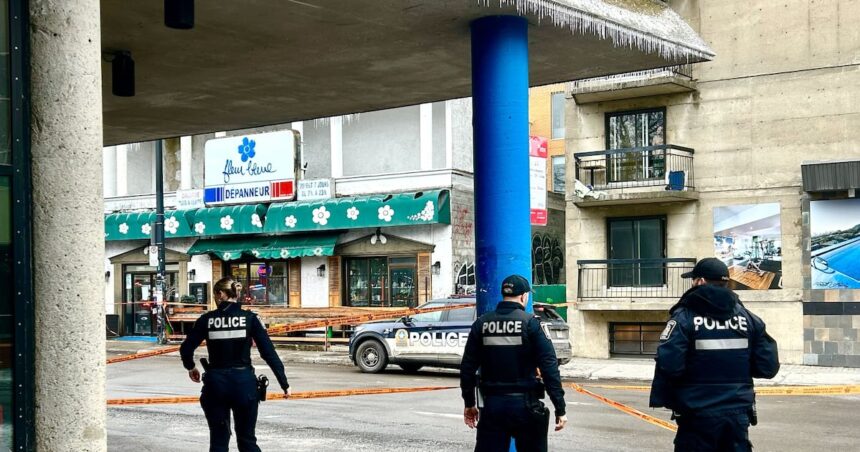

A quiet Thursday morning near Laurier metro station shattered when police discovered a man’s body inside a business on Laurier Avenue East. The victim, found with stab wounds, died at the scene. Montreal police arrested a suspect shortly after. The incident has left this typically peaceful Plateau neighbourhood shaken and searching for answers.
Officers from the Service de police de la Ville de Montréal responded to an emergency call around 7:30 a.m. When they arrived at the commercial building, they found a man in his fifties who had suffered fatal injuries. Paramedics declared him dead at the location. The business remained closed as investigators secured the area and began collecting evidence.
I’ve walked past Laurier metro countless times while covering stories in this neighbourhood. The station sits in the heart of Montreal’s Plateau-Mont-Royal district, surrounded by cafes, boutiques, and local businesses. It’s the kind of area where people grab their morning coffee without a second thought about safety. This violent incident feels particularly jarring against that familiar backdrop.
Police spokesperson Constable Véronique Comtois confirmed that investigators quickly identified a suspect. Officers located and arrested a man connected to the victim within hours of discovering the body. The suspect was taken into custody and awaits formal charges. Authorities have not released his identity pending the investigation’s progression.
The relationship between the victim and suspect remains under investigation. Police indicated the two men knew each other, suggesting this wasn’t a random attack. Homicide detectives from Montreal’s major crimes unit took over the case. They’re working to establish a timeline of events leading to the fatal confrontation.
The Plateau-Mont-Royal borough has historically maintained lower violent crime rates compared to other Montreal districts. According to Statistics Canada data, the area reported fewer than five homicides annually over the past decade. Residents describe their neighbourhood as vibrant and family-friendly, making Thursday’s stabbing particularly unsettling for locals.
Marie-Claude Bergeron, who owns a nearby flower shop, expressed shock at the news. She told reporters she’s operated her business on Laurier for fifteen years without experiencing serious incidents. “We know our neighbours here,” she said. “Everyone looks out for each other. This feels completely out of character for our street.”
The business where the stabbing occurred has not been publicly identified by authorities. Police maintained a visible presence throughout the day, canvassing nearby establishments for security footage. Investigators interviewed potential witnesses who may have seen suspicious activity in the early morning hours.
Montreal has experienced fluctuating violent crime rates in recent years. The city recorded 31 homicides in 2023, according to SPVM annual reports. While that number represents a decrease from previous years, each incident ripples through affected communities. Stabbing deaths account for approximately thirty percent of Montreal homicides, based on provincial crime statistics.
This case highlights ongoing concerns about conflict resolution and public safety in urban environments. Dr. Samuel Tanner, a criminology professor at Université de Montréal, has studied violence patterns in Quebec cities. He notes that most homicides involve people who know each other, often stemming from personal disputes rather than stranger attacks.
The Laurier metro station serves thousands of commuters daily on the orange line. It connects residential neighbourhoods with downtown Montreal and remains a crucial transit hub. Metro operations continued normally throughout the investigation, though police presence near the station increased noticeably.
Local community organizations have emphasized the importance of maintaining perspective. Sûreté du Québec data shows Montreal remains one of Canada’s safer major cities overall. However, isolated violent incidents can significantly impact residents’ sense of security, particularly in neighbourhoods unaccustomed to such events.
I remember covering a neighbourhood safety forum in the Plateau last year. Residents voiced concerns about minor property crimes but expressed confidence in their community’s overall security. Thursday’s incident will likely prompt renewed discussions about violence prevention and community policing strategies.
The victim’s identity has not been officially released pending family notification. Police followed standard protocol in withholding names until next of kin could be informed. The coroner’s office will conduct an autopsy to confirm the exact cause of death and document the nature of injuries sustained.
Montreal’s homicide unit maintains one of Quebec’s higher case resolution rates. According to SPVM statistics, investigators solve approximately seventy-five percent of homicide cases within the first year. The quick arrest in this case suggests police had substantial evidence connecting the suspect to the crime.
Legal proceedings will unfold in Quebec’s judicial system over coming months. The suspect will appear before a judge for bail hearing and formal charge reading. Quebec’s criminal code treats homicide cases with utmost seriousness, involving extensive investigation and prosecution resources.
Community leaders have called for calm while supporting affected families and neighbours. Borough councillor Josefina Blanco released a statement expressing condolences and confidence in police investigative work. She encouraged residents with information to contact authorities through Montreal’s confidential tip line.
The incident serves as a sobering reminder that violence can emerge unexpectedly even in familiar surroundings. As Montreal continues growing and evolving, maintaining community connections and responsive emergency services remains essential. The Plateau neighbourhood will likely need time to process this tragedy and restore its characteristic sense of security.