
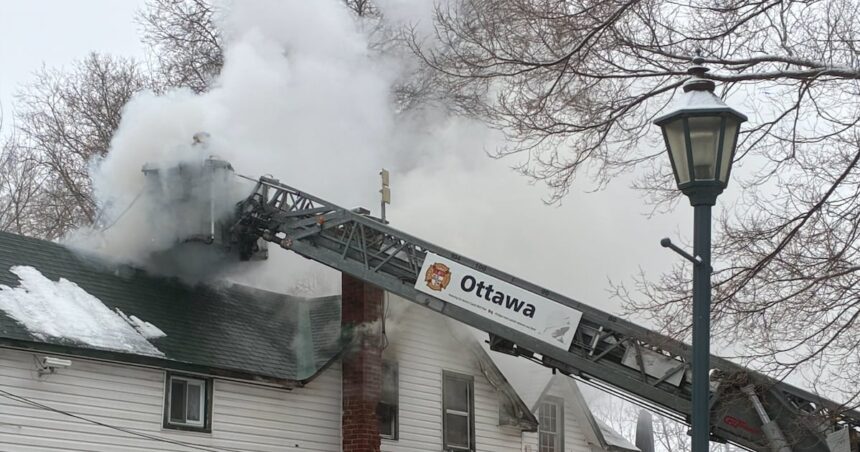

Eva Racine stood on Manotick Main Street watching flames consume her home of twelve years. She’d left just moments earlier to drive her son to work. When she returned, fire trucks lined the narrow street and smoke poured from her apartment windows.
I’ve covered countless emergencies across Ottawa, but house fires hit differently in tight-knit communities like Manotick. Everyone knows someone affected. The village spirit makes these losses feel deeply personal for residents who’ve built their lives along the historic main street.
Ottawa Fire Services received multiple 911 calls shortly before 8 a.m. on Sunday morning. Witnesses reported smoke and flames billowing from a building near Eastman Avenue. Nick DeFazio, the service’s public information officer, confirmed crews arrived to find fire threatening both residential and commercial spaces.
The structure houses a business on the main floor. Racine’s apartment sits above. She operates an at-home sewing business from her living space. Years of fabric, equipment, and completed projects likely went up in smoke.
She learned about the fire in the most jarring way possible. The car wash owner drove past and broke the news. He pointed toward her building engulfed in flames. Reality hit hard in that moment.
Racine spoke with reporters from the scene. Her voice carried the shock that follows sudden loss. “I’m devastated,” she explained to CTV News Ottawa. “They said it started in the kitchen, and I can’t think of what would have started in the kitchen.”
Fire origin investigations take time. Crews must sift through debris and examine electrical systems. Kitchen fires typically involve cooking equipment, appliances, or electrical faults. Racine’s confusion suggests she’d taken normal precautions before leaving.
Ottawa firefighters deployed aggressive tactics to contain the blaze. Crews set up an aerial ladder to attack flames from above. The elevated position gives firefighters advantage when tackling upper-story fires. Other team members entered the structure to suppress fire spreading through interior spaces.
DeFazio noted the building’s age and renovation history complicated firefighting efforts. Older structures often contain hidden voids where fire travels undetected. Multiple renovations create unexpected pathways for flame spread. These factors extend the time needed to fully extinguish hot spots.
I’ve watched our firefighters work through similar challenges in heritage districts. Ottawa’s older neighborhoods feature beautiful historic buildings that present unique firefighting obstacles. Crews train specifically for these scenarios, but each building holds surprises.
The fire was declared under control shortly after 11 a.m. That three-hour window represents intense physical labor in dangerous conditions. Firefighters battled flames while monitoring structural stability and searching for remaining hot spots.
Paramedics remained on scene throughout the operation. Fortunately, no injuries occurred. Racine had left before fire started. No employees worked in the downstairs business that early Sunday morning.
The human cost extends beyond physical harm. Racine lost her cat in the fire. Pet losses devastate families who consider animals cherished members. Her service dog Merlin was with her during the work trip. That small mercy provided one bright spot amid catastrophic loss.
Ottawa Police closed Manotick Main Street for several hours. The closure allowed firefighters safe working space and kept onlookers at safe distances. Traffic resumed later that day after crews confirmed the scene was secure.
Manotick’s main street serves as the community’s heart. Local businesses depend on Sunday traffic. Road closures ripple through the small village economy. But public safety always takes priority over commercial concerns.
Racine now faces the overwhelming task of rebuilding her life. The Red Cross stepped in immediately offering temporary shelter assistance. The organization provides critical support during those first disorienting hours and days following displacement.
She expressed deep uncertainty about her future. “I’ve lived here for a long time in that apartment,” Racine told reporters. “I don’t know if I’m going to be able to find another place.”
Ottawa’s rental market has tightened considerably in recent years. Finding affordable housing presents challenges even under normal circumstances. Displaced fire victims face additional hurdles including lack of references and immediate move-in needs.
Racine’s sewing business represented both income and passion. Replacing industrial sewing equipment, fabric inventory, and client projects requires substantial investment. Insurance helps when available, but business interruption creates immediate financial pressure.
She doubts anything remains salvageable. “I don’t even know if anything in that apartment is salvageable,” she said from the scene. Smoke and water damage often destroy items that flames never touched.
Fire investigation teams will examine the kitchen area where flames reportedly originated. Their findings help prevent future incidents and provide answers to devastated property owners. The process takes days or weeks depending on damage severity.
Community response will likely mobilize quickly. Manotick residents rally around neighbors facing hardship. Fundraising campaigns and donation drives often emerge within hours of publicized losses. That village spirit provides emotional and practical support.
Ottawa Fire Services continues encouraging residents to maintain working smoke alarms. Early detection saves lives and property. Regular appliance maintenance and caution around cooking equipment prevent many kitchen fires.
This incident marks another reminder of how quickly life changes. Racine left for a routine errand and returned homeless. Those of us covering local news witness these transformations regularly. They underscore the importance of emergency preparedness and community support networks.
The investigation continues as Racine begins picking up pieces of her disrupted life.