
Walking past the newly opened Café Souverain on rue Saint-Denis last Tuesday, I noticed something unusual. The storefront wasn’t just selling coffee and croissants. It was selling an idea that has shaped Quebec for generations.
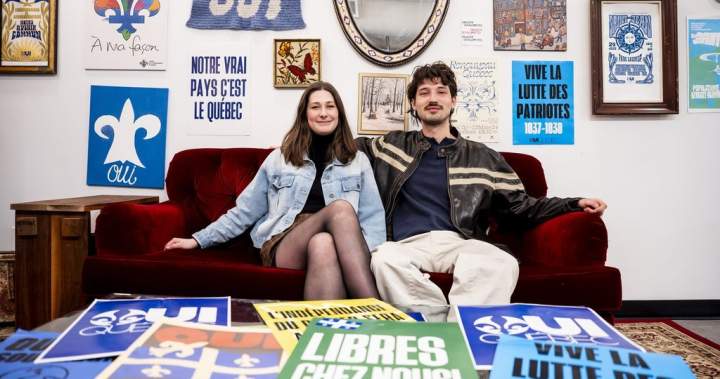
The café opened its doors three weeks ago in the Plateau. Owner Marie-Claude Beaulieu designed every detail around Quebec independence. The blue and white colour scheme mirrors the fleurdelysé flag. Local artists created murals depicting historic moments from the sovereignty movement.
Beaulieu told me she wanted to create a space where people could discuss Quebec’s future. She spent fifteen years working in Ottawa before returning to Montreal. The experience changed her perspective on Quebec’s place within Canada.
“I saw how decisions affecting us were made far away,” she explained. “We needed a gathering place for these conversations.”
The menu itself makes a political statement. Every item bears names connected to the independence movement. The “René” espresso honours former Premier René Lévesque. The “1995” latte remembers the referendum that nearly changed everything.
According to a recent Léger poll, support for Quebec independence sits at thirty-two percent. That number hasn’t shifted dramatically in years. Yet Beaulieu believes younger generations need spaces to explore these questions.
The café features a small library with books about Quebec history. Titles range from academic works to personal memoirs. Customers can borrow books or simply read while enjoying their coffee.
Professor Jean-François Nadeau from UQAM studies Quebec nationalism. He visited the café during opening week. The space represents something important, he told me during our phone conversation.
“Political cafés have deep roots in Montreal history,” Nadeau explained. “They’ve always been where ideas ferment and movements begin.”
The décor includes photographs from key moments in sovereignty history. Images from the Quiet Revolution hang beside pictures from referendum nights. One wall displays quotes from prominent independence advocates throughout decades.
Local artist Claudette Rousseau contributed a large canvas for the main wall. Her painting depicts the Saint Lawrence River flowing through stylized Quebec landmarks. She described it as representing Quebec’s distinct cultural current.
“The river shows we’re connected but separate,” Rousseau said. “We have our own flow within the larger waters.”
Not everyone in the neighbourhood welcomes this political approach. Some residents worry the café might divide rather than unite. Others question whether business should mix so directly with political advocacy.
I spoke with Daniel Greenwood, whose family has owned a bookstore nearby for decades. He respects Beaulieu’s right to express her views. However, he feels Montreal thrives because of its diversity of opinions.
“The Plateau works because we have federalists and sovereigntists as neighbours,” Greenwood noted. “I hope the café welcomes all perspectives, not just one.”
Beaulieu insists the space remains open to respectful debate. She hired staff representing different political viewpoints. The goal isn’t indoctrination, she emphasized. It’s providing a venue for genuine dialogue.
The café hosts weekly discussion evenings on Thursday nights. Topics range from language preservation to economic sovereignty. Last week’s session attracted forty people spanning multiple generations.
Young professional Thomas Mercier attended that first discussion. He was born after the 1995 referendum. The independence question feels abstract to many in his generation. The café gives it tangible presence in daily life.
“We learn about referendums in school,” Mercier shared. “But here, we actually talk about what sovereignty could mean today.”
Statistics Canada data shows Montreal’s francophone population faces demographic shifts. The percentage of French speakers in greater Montreal declined slightly over recent years. Language remains central to independence discussions.
The café serves as a French-first space. Staff greet customers in French before switching to English if needed. This approach reflects Bill 96 and Quebec’s language protection efforts.
McGill University political scientist Catherine Vallières researches Quebec identity formation. She sees the café as part of broader cultural preservation efforts. Economic arguments for independence have evolved, but cultural motivations remain strong.
“Sovereignty supporters today worry less about economic control,” Vallières explained. “They worry more about cultural survival in North America.”
The café sources all products from Quebec suppliers. Coffee comes from a Quebecois roaster. Pastries arrive from a bakery in Rosemont. Even the furniture was crafted by artisans from the Eastern Townships.
This hyperlocal approach reflects economic nationalism at small scale. Beaulieu wants customers to see sovereignty as supporting Quebec creators. Every purchase becomes a micro-statement about economic self-determination.
Revenue during the first three weeks exceeded Beaulieu’s projections. The concept clearly resonates with enough Montrealers to sustain the business. Whether it sparks broader political engagement remains to be seen.
I’ve covered Montreal’s cultural landscape for nearly two decades. Political expression through business isn’t new here. But the directness of this approach feels notable. Most establishments keep political affiliations subtle.
The café sits in a neighbourhood with strong sovereigntist history. The Plateau voted overwhelmingly “yes” in past referendums. Beaulieu chose her location strategically, planting her flag in sympathetic territory.
Student Amélie Tremblay studies at Université de Montréal nearby. She visits the café between classes. Growing up, her parents held opposing views on independence. The café gives her space to form her own position.
“My mom wanted sovereignty, my dad didn’t,” Tremblay said. “I never knew where I stood until I could explore it myself.”
Whether Café Souverain represents a sovereignty movement resurgence or simply creative entrepreneurship remains unclear. Support for independence hasn’t surged recently. But the conversation never truly disappears in Quebec.
Walking out after my visit, I noticed the café’s tagline painted on the window. “Un pays se construit un café à la fois.” A country is built one coffee at a time. Whether that country will be Quebec or remain Canada, this café gives people a place to debate over espresso and ideas.