
I remember the first time I landed at LaGuardia. The approach felt impossibly tight, the runway seemingly carved between water and city. Every Montreal journalist who covers travel knows that route intimately. We’ve flown it countless times, following stories between our two cities.
Sunday night shattered that familiar corridor with devastating finality.
Two Air Canada pilots died when their flight from Montreal’s Pierre Elliott Trudeau International Airport collided with a fire truck at LaGuardia Airport. The Jazz Aviation aircraft, carrying 76 people total, slammed into the emergency vehicle around 11:30 p.m. while touching down on Runway 4.
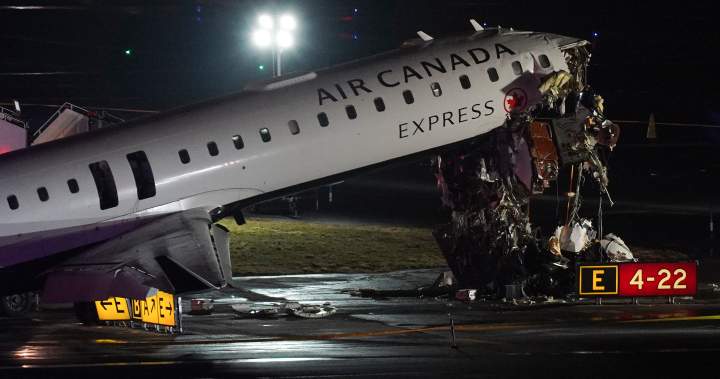
The cockpit crumpled on impact. Cables and debris hung from the mangled front section. The Mitsubishi CRJ-900 jet tilted upward, its nose destroyed, resting at an unnatural angle.
I’ve walked through Trudeau countless times, watching crews prepare for departure. These pilots would have completed their pre-flight checks just hours before the crash. They would have taxied past the same terminals I photograph for cultural stories about Montreal’s international connections.
Now their families face unimaginable grief.
Kathryn Garcia serves as executive director of the Port Authority of New York and New Jersey. She confirmed all 72 passengers and four crew members were accounted for Monday morning. The two Canadian-based pilots, however, did not survive.
“The pilot and the first officer were killed in this accident,” Air Canada stated Monday. “We are deeply saddened by the loss of two Jazz employees.”
Garcia told reporters that 41 people were transported to two Queens hospitals. Medical teams released 32 patients relatively quickly. Nine remained hospitalized as of early Monday, some with serious injuries.
Two Port Authority employees traveling inside the fire truck also suffered injuries, though Garcia described them as non-life-threatening. The emergency vehicle ended up on its side near the damaged aircraft.
Prime Minister Mark Carney released a statement calling the collision “deeply saddening.” He confirmed Canadian officials are working closely with American counterparts as the investigation unfolds. His thoughts, he said, remain with victims, families, and everyone impacted.
The Transportation Safety Board of Canada deployed investigators to support the National Transportation Safety Board. Both agencies are conducting a thorough examination of what went catastrophically wrong.
LaGuardia Airport closed immediately following the crash. The facility remained shut down until at least 2 p.m. Monday to allow investigators complete access to the scene.
“The airport is currently closed to facilitate the response and allow for a thorough investigation,” LaGuardia posted on X Monday morning. “This is a developing situation based on preliminary information.”
The sequence of events reveals troubling complexity.
The fire truck was crossing Runway 4 while responding to a separate incident. A United Airlines flight had reported an odour during takeoff. Garcia confirmed this unrelated issue prompted the emergency vehicle’s movement across the active runway.
The Associated Press obtained radio transmissions from moments before impact. An air traffic controller can be heard giving clearance to a vehicle crossing part of the tarmac. Then urgency floods the transmission as the controller tries desperately to stop the movement.
Seconds later, the controller frantically diverts incoming aircraft from landing. The panic in those recordings tells the story before official reports ever could.
Doug Clarke, president of Jazz Aviation, called it an “incredibly difficult day” for the airline. His statement acknowledged the profound loss rippling through their aviation family.
“As the investigation unfolds, we are fully committed to cooperating with the relevant authorities to determine what happened,” Clarke said. “We will share updates as soon as verified information becomes available.”
Air Canada and Jazz Aviation both pledged full cooperation with Canadian and American investigators. They promised support for affected families in the coming days and weeks.
Photographs from the scene show stairways positioned against the aircraft’s emergency exits. Passengers evacuated through those doors, escaping a jet whose cockpit no longer existed as a recognizable structure.
I think about the passengers from Montreal aboard that flight. Perhaps they were returning from business meetings or visiting family. Maybe they were starting New York vacations or heading to connecting flights.
They boarded expecting a routine hour-long journey. Instead, they witnessed their pilots die while trying to land safely.
The CRJ-900 operates regularly between Montreal and numerous American destinations. Jazz Aviation, as Air Canada’s regional carrier, maintains extensive operations from Trudeau Airport. These crews represent the backbone of our city’s connectivity to the world.
Montreal’s aviation community is tight-knit. Pilots, flight attendants, and ground crews know each other. They share stories at crew lounges and local restaurants near the airport. This loss will reverberate through countless conversations and quiet moments of reflection.
The investigation will examine communication protocols between air traffic control and ground vehicles. It will analyze why a fire truck crossed an active runway during landing operations. It will scrutinize timing, clearances, and decision-making under pressure.
Those technical findings matter enormously for preventing future tragedies.
But right now, two families are planning funerals. Colleagues are remembering shared flights and professional camaraderie. The Jazz Aviation community is grieving pilots who will never return to Montreal.
LaGuardia has long been considered one of America’s most challenging airports. Space constraints, intersecting runways, and heavy traffic create constant complexity. Every pilot knows the demands of operating there.
These pilots navigated those challenges successfully before. Sunday night, circumstances beyond their control converged with fatal consequences.
As Montreal processes this tragedy, we’re reminded how quickly normalcy shatters. A routine flight becomes a disaster. Professionals doing their jobs lose their lives. Passengers carry trauma that will last far beyond physical injuries.
The investigation will take months. Answers will emerge slowly, methodically, through painstaking analysis.
For now, Montreal mourns two more lives lost to aviation tragedy. We wait for details. We support grieving families. And we recognize the fragility underlying every departure and arrival we take for granted.