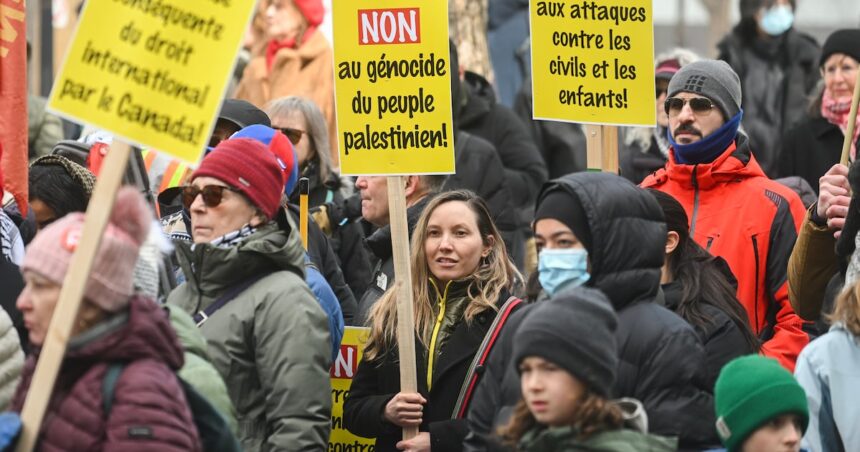

Downtown Montreal filled with voices Saturday afternoon. Hundreds gathered to send a clear message to Ottawa. They want Canada to stay out of Middle East wars.
The crowd moved through familiar streets near Place des Arts. I’ve covered many protests in this city over two decades. This one carried a particular weight of urgency and personal connection.
“In Iran, enough war,” protesters chanted in unison. Their voices bounced off the glass towers lining Rue Sainte-Catherine. “U.S., back off, Iran is not yours,” echoed through the crisp spring air.
Four groups organized the demonstration together. Stop the War Collective joined forces with Divest for Palestine. The Quebec Emergency Palestine Coalition and Palestinian Youth Movement rounded out the coalition. Their combined effort brought diverse voices to one intersection.
Prime Minister Mark Carney’s recent statements triggered much of the frustration. He suggested Canada might help secure the Strait of Hormuz. Yet he also said Canada wouldn’t join the conflict directly. Many protesters saw contradiction in those words.
Mona Ghassemi didn’t mince words when she addressed the gathering. She leads the Canadian-Iranian Congress as president and spokesperson. “The Canadian-Iranian Congress condemns Prime Minister Mark Carney’s hypocritical support of U.S.-Israeli aggression against Iran,” she declared.
Her statement drew loud cheers from the crowd. I noticed several people holding signs in both English and French. This bilingual expression felt quintessentially Montreal to me.
Raymond Legault spoke next, representing Stop the War Collective. He outlined the protest’s broader goals clearly. “We oppose U.S. and Israeli wars in Lebanon and Iran,” he explained. The demonstration also aimed to denounce ongoing violence in Gaza. Legault demanded Canada speak out and refuse participation in these military actions.
Boutaina Chafi brought the Palestinian Youth Movement’s perspective to the microphone. She reminded everyone that Quebecers have pressed the federal government for months. Their demand remains consistent: stop arms shipments to Israel through the United States.
“As long as Carney does not respond to the demands of the majority of the population, we will continue to mobilize,” Chafi stated in her press release. Her determination reflected what I heard from numerous protesters throughout the afternoon.
She elaborated during an interview amid the demonstration. “The goal is to send a strong message,” Chafi said. “Democracy in our countries cannot come through bombing, destruction, or killing civilians. That is not how change happens.”
I spoke with Danielle, a protester who articulated her frustration clearly. She opposed the war because it “has no justification.” She called it “against the international order.”
Her next observation struck me as particularly sharp. “When Israel invaded Gaza to carry out its genocide, people said Israel has the right to defend itself,” Danielle noted. “Now people are saying Iran has no right to defend itself. What does that even mean?”
She concluded with a firm statement about Canadian involvement. “The Canadian government should never offer to participate in a war like this,” she said.
Many protesters carried personal stakes in these conflicts. An Iranian woman I encountered had family still living partly in Iran. She came specifically to speak out against the war. Her concern for relatives remained palpable in her voice.
Sami shared an even more direct connection to the violence. His family had suffered tremendously from the conflict’s reach. “My entire family in Lebanon has been displaced,” he told reporters. “I lost members of my family, especially for imperialist goals by Israel and American capitalists.”
The pain in his words reminded me why journalism matters. These aren’t abstract geopolitical debates. Real families face displacement and loss daily.
Greg Beaune attended representing the Quebec Peace Movement as vice-president. His organization campaigns against war broadly, not just specific conflicts. They mobilized to send what he called a clear anti-imperialist message.
“For us, it is very important, as members of Quebec and Canadian society, to mobilize widely,” Beaune explained. His goal centered on maintaining pressure on the Carney government. “We need to prevent it from making a very bad decision,” he said. “That would be to side with the United States.”
The demonstration reflected something I’ve observed increasingly in Montreal. Our city’s multicultural fabric makes international conflicts feel intensely local. Iranian-Canadians, Lebanese-Canadians, and Palestinian-Canadians don’t view Middle East wars as distant events.
They’re watching family members navigate bombings and displacement. They’re mourning losses that official statements reduce to statistics. Their presence at protests brings urgency that transcends typical political activism.
Walking among the crowd, I noticed the age range spanned generations. Young students marched alongside older activists who’ve protested wars for decades. Parents pushed strollers while holding signs. Teenagers filmed speeches on their phones.
This diversity matters for understanding Montreal’s political consciousness. The city has long embraced international solidarity movements. From anti-apartheid protests to recent climate demonstrations, Montrealers consistently turn out for global justice issues.
The protest concluded peacefully as afternoon light faded over Mount Royal. Organizers promised continued action if Ottawa doesn’t shift its position. They’re planning more mobilizations in coming weeks.
Prime Minister Carney now faces sustained pressure from Quebec’s largest city. His government must navigate complex international alliances while addressing citizen concerns. The Strait of Hormuz represents crucial global shipping lanes. Yet many Canadians question military involvement in volatile regions.
Saturday’s demonstration highlighted tensions between geopolitical strategy and public opinion. It showcased Montreal’s role as a hub for international solidarity. And it reminded politicians that foreign policy decisions carry domestic political consequences.
The protesters dispersed gradually, conversations continuing on metro platforms and sidewalks. Their message remained clear and unwavering. They want Canada to choose peace over military entanglement. They’re demanding their government listen to citizens, not just allied powers.
Whether Ottawa responds remains uncertain. But one thing became obvious Saturday afternoon. Montreal’s streets will keep filling with voices demanding change until someone in power truly listens.