
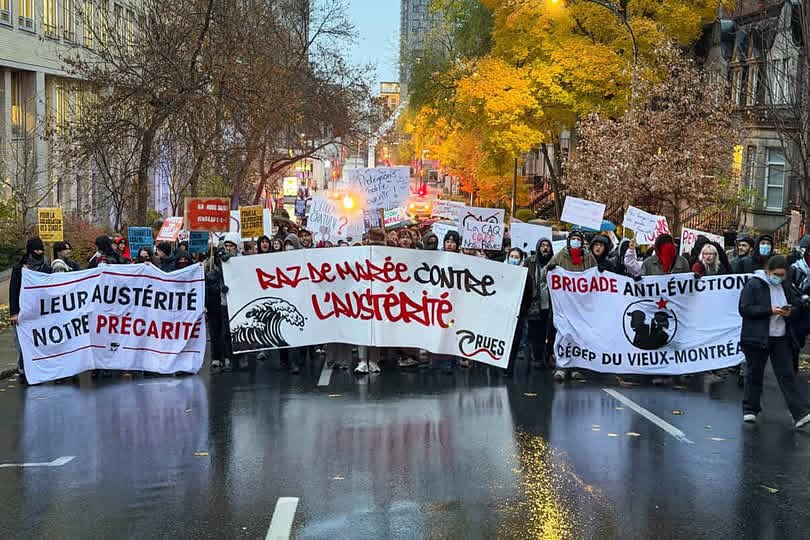

I watched from my apartment window this morning as groups of students streamed down Rue Saint-Denis with handmade signs. Their voices carried up through the cool March air. This is Montreal in protest mode, a familiar rhythm in our city’s heartbeat.
More than 55,000 college and university students across Quebec walked out of class this week. They’re demanding better funding for education. The strike runs from March 23 through March 27, organized by the Coalition de résistance pour l’unité étudiante syndicale, known as CRUES.
I’ve covered student movements in Montreal for nearly two decades now. This one feels different. There’s a quiet desperation beneath the chants. These aren’t just students angry about tuition hikes. They’re fighting against what they call the slow decay of their institutions.
The provincial government announced a 2.4 percent increase in education spending for the 2026-27 budget. That sounds reasonable until you dig deeper. The Institute for Research and Socioeconomic Information, or IRIS, calculated that education actually needs a 3.8 percent boost just to keep pace with rising costs. That gap might seem small on paper. In reality, it translates to crumbling buildings and disappearing support services.
Elki Mercier coordinates CRUES and spoke bluntly about the situation. “While the government hasn’t openly attacked postsecondary education, it has clearly let it rot for years,” Mercier stated in a press release Monday. That word choice struck me. Rot. It’s visceral and uncomfortable. It’s also accurate according to many students I’ve spoken with over coffee in recent weeks.
Walking through Concordia’s campus last week, I noticed peeling paint in hallways. Outdated computer labs. Crowded study spaces with broken furniture. These aren’t dramatic catastrophes. They’re the accumulation of years of deferred maintenance and hiring freezes. Death by a thousand budget cuts, as one student told me.
The hiring freezes have hit student services particularly hard. Fewer counselors mean longer wait times for mental health support. Reduced staff in financial aid offices create bottlenecks. Academic advisors juggle impossible caseloads. International students, who pay significantly higher fees, often find the least support available when they need it most.
I stopped by Université de Montréal’s campus yesterday afternoon. A group of students had set up information tables near the main library. One young woman, a third-year sociology major, explained her frustration. She pays nearly $3,000 per semester in fees and ancillary costs. Yet the computer she needs for her thesis research keeps crashing. The writing center she depends on reduced its hours. Her professors, overworked and understaffed, struggle to provide meaningful feedback.
The financial assistance program, Aide financière aux études or AFE, has become a particular flashpoint. CRUES argues that the bursaries provided don’t cover basic living expenses. In a city where rent continues climbing and grocery bills shock even longtime residents, students find themselves choosing between textbooks and meals.
Food insecurity among students isn’t a peripheral issue anymore. Campus food banks report increased demand every semester. I visited one at a CEGEP in the Plateau last month. The shelves looked sparse. The coordinator told me they’re serving twice as many students as they did three years ago. Many come from middle-class families who never imagined needing this kind of help.
Naïma Le Nédic, an internal coordinator for CRUES, warned that this week’s strike might just be the beginning. “The students will continue to escalate their pressure tactics, which could go as far as an indefinite general strike,” Le Nédic said. She added something that resonated with Montreal’s political memory. “We refuse to negotiate our own impoverishment, regardless of which political party is in power.”
That statement recalls the Maple Spring of 2012, when student protests paralyzed the city for months. I covered those demonstrations too. The red squares pinned to jackets became symbols of resistance. Nightly marches turned downtown into a drumbeat of dissent. This current movement hasn’t reached that intensity yet. But the infrastructure is there. The organizational networks. The collective memory.
Monday evening, CRUES planned a major rally in Montreal. These gatherings serve multiple purposes beyond visibility. They build solidarity across different campuses and linguistic divides. They allow students from francophone CEGEPs and anglophone universities to recognize their shared struggles. In bilingual Montreal, that unity carries particular weight.
The government’s response so far has been muted. Officials point to the budget increase as evidence of commitment to education. They highlight other priorities competing for limited funds. Healthcare, infrastructure, climate initiatives. All legitimate concerns. All inadequate excuses when lecture halls leak and students go hungry.
I spoke with a professor at McGill who asked to remain anonymous. She described the moral injury of watching her students struggle. Brilliant minds limited not by ability but by circumstances. Research projects abandoned because lab equipment breaks down. Graduate students delaying degrees because they can’t afford another semester of poverty-level stipends.
The economic argument for investing in education seems obvious. Quebec needs educated workers for its growing tech sector. For its creative industries. For healthcare and social services facing demographic pressures. Penny-wise, pound-foolish, as the English expression goes. Or as we might say in French, économiser sur l’allumette et gaspiller la chandelle.
But this strike isn’t really about economics, at least not entirely. It’s about dignity. About the social contract between a society and its young people. About whether we value education as a public good or tolerate its gradual privatization through neglect.
Walking back through downtown after the rally, I noticed how many storefronts have closed recently. How many “for rent” signs dot the boulevard. Montreal is changing rapidly. Students fear their institutions are being left behind, crumbling while new condo towers rise around them.
The week-long strike will end Friday. Classes will resume. But the underlying issues remain unresolved. Hiring freezes continue. Buildings keep deteriorating. Bursaries stay inadequate. Unless something shifts at the provincial level, Le Nédic’s warning about an indefinite strike might become reality.
I’ve learned over years of journalism that protests reveal what a society values. What it’s willing to fight for. These 55,000 students striking this week are fighting for more than their own interests. They’re defending an idea of accessible, quality public education that has defined Quebec for generations.
Whether anyone in power is listening remains the question.