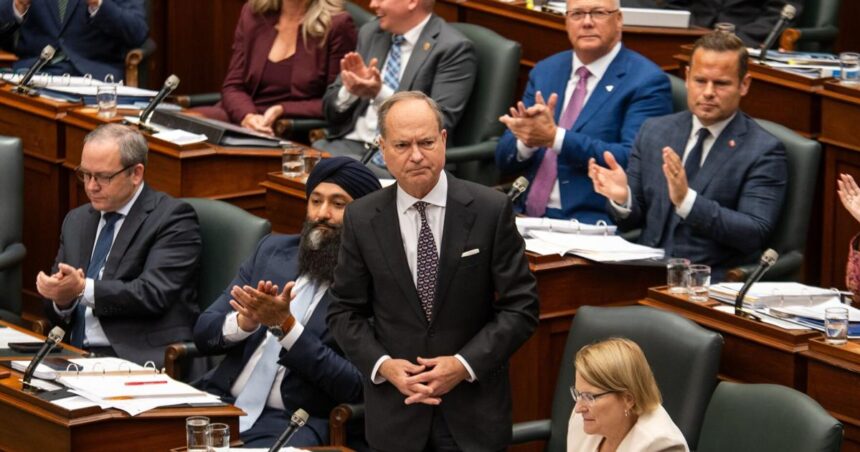

I’ve been covering provincial politics long enough to recognize when the tone shifts from optimistic to cautious. Last week, Ontario’s Finance Minister Peter Bethlenfalvy delivered a message that caught my attention during what should have been routine economic commentary. He warned Ontarians to prepare for tougher economic times ahead, a stark departure from the reassuring statements we’ve grown accustomed to hearing from Queen’s Park.
The warning came during a fiscal update that painted a sobering picture of Ontario’s economic landscape. Bethlenfalvy didn’t sugarcoat the challenges facing our province. He acknowledged that global economic headwinds are creating uncertainty that will inevitably impact households and businesses across Ontario. This wasn’t the usual political hedging I’ve heard countless times in press conferences. The minister’s words carried genuine concern about what lies ahead for Canada’s most populous province.
What struck me most was the timing. We’re emerging from years of pandemic-related economic disruption, and many Toronto businesses I’ve interviewed recently were just finding their footing again. Small retailers along Queen Street West told me last month they were finally seeing customer traffic return to pre-pandemic levels. Restaurant owners in the Distillery District expressed cautious optimism about their upcoming quarter. Now those same business owners will need to recalibrate their expectations based on this provincial warning.
The finance minister pointed to several factors driving this pessimistic outlook. International trade tensions remain unresolved, creating supply chain complications that Ontario manufacturers continue to grapple with. Interest rates, while showing signs of stabilization, remain significantly higher than the rock-bottom levels businesses enjoyed just a few years ago. These elevated borrowing costs are squeezing both corporate expansion plans and household budgets in ways that aren’t immediately visible but accumulate over time.
I spoke with Sarah Chen, owner of a mid-sized manufacturing firm in Scarborough, about how these warnings translate to ground-level business decisions. She explained that uncertainty itself becomes a cost factor. When provincial leadership signals tougher times, businesses naturally become more conservative with hiring, equipment purchases, and expansion plans. Her company had planned to add fifteen new positions this spring but is now reconsidering that timeline. This hesitation, multiplied across thousands of Ontario businesses, can become a self-fulfilling prophecy.
The retail sector faces particularly acute challenges according to the finance minister’s assessment. Consumer spending drives a substantial portion of Ontario’s economic activity, especially in Toronto where shopping districts generate billions annually. When households feel economic pressure, discretionary spending drops first. Fashion boutiques, home furnishing stores, and restaurants feel this contraction before anyone else. I’ve watched this pattern play out during previous downturns, and the early warning signs are already appearing.
Bethlenfalvy emphasized that the provincial government isn’t sitting idle in the face of these challenges. Ontario has committed to maintaining infrastructure spending, which provides some economic cushioning during difficult periods. Construction projects across the Greater Toronto Area continue moving forward, from transit expansions to hospital upgrades. These investments create jobs and stimulate economic activity even when private sector spending contracts. The finance minister positioned this infrastructure push as a strategic buffer against broader economic headwinds.
However, infrastructure spending alone won’t insulate Ontario from global economic realities. The province remains deeply integrated into international trade networks, particularly with the United States. Any disruption to cross-border commerce immediately affects Ontario’s manufacturing heartland. Automotive plants, steel producers, and technology firms all depend on seamless trade relationships. The finance minister’s warning reflects genuine concern about potential disruptions to these critical economic arteries.
Housing affordability continues complicating Ontario’s economic picture. Toronto residents face some of North America’s highest housing costs, which consumes an outsized portion of household income. When people spend sixty or seventy percent of their earnings on shelter, they have little left for other purchases. This constraint dampens consumer spending across the board, from clothing to entertainment to dining out. The finance minister acknowledged this ongoing challenge but offered few concrete solutions during his recent statements.
Local economists I’ve consulted expressed mixed reactions to the provincial warning. Dr. James Morrison from the University of Toronto’s economics department told me that transparent communication about economic risks helps businesses and households prepare appropriately. He appreciates the government acknowledging challenges rather than painting an unrealistically rosy picture. However, he cautioned that overly pessimistic messaging can trigger unnecessary panic and accelerate economic slowdowns through reduced confidence.
The employment landscape will likely feel these economic pressures unevenly. Toronto’s technology sector continues showing resilience, with companies still recruiting skilled workers despite broader economic concerns. However, retail and hospitality workers face greater vulnerability during economic contractions. These frontline service positions often disappear quickly when businesses tighten budgets. I’ve interviewed workers in both sectors, and the anxiety is palpable among those without specialized skills or education credentials.
Small business owners across Toronto are already implementing defensive strategies. Maria Rodriguez, who runs three coffee shops in the downtown core, explained her approach to navigating uncertain times. She’s reducing inventory levels to preserve cash flow and postponing her planned fourth location. These micro-decisions, repeated across thousands of small businesses, create measurable economic drag. The finance minister’s warning validates the caution these entrepreneurs are already feeling.
Provincial revenue projections will inevitably suffer if economic conditions deteriorate as forecasted. Lower business activity means reduced corporate tax collections. Struggling households generate less sales tax revenue. This creates a fiscal squeeze where the government has less money precisely when social services face increased demand. Bethlenfalvy’s warning serves partly as preemptive explanation for potential budget shortfalls ahead. Managing public expectations now makes future difficult decisions slightly easier to justify politically.
The agricultural sector, often overlooked in urban-centric economic discussions, faces its own set of challenges. Ontario farmers deal with input cost pressures, unpredictable weather patterns, and international commodity price fluctuations. The finance minister’s broader economic warning encompasses rural Ontario as much as urban centers. Farmers I’ve spoken with near Guelph and Cambridge express frustration about factors beyond their control repeatedly undermining their planning efforts.
What remains unclear is how long these tougher economic conditions might persist. The finance minister offered no specific timeline, which is both honest and unsettling. Economic forecasting carries inherent uncertainty, particularly given how interconnected global markets have become. A trade dispute, geopolitical crisis, or financial market disruption anywhere can ripple through Ontario’s economy within days. This volatility makes definitive predictions nearly impossible.
Toronto’s cultural and creative industries could face particular vulnerability during an economic slowdown. Theater companies, galleries, and music venues depend on discretionary spending from audiences who can easily cut entertainment budgets when finances tighten. I’ve covered this sector extensively and know how quickly support evaporates during tough times. Government arts funding becomes controversial precisely when it’s needed most by struggling cultural organizations.
The finance minister’s statement ultimately serves as a call for prudent financial management at all levels. Households should reconsider major purchases and build emergency savings if possible. Businesses need realistic planning that accounts for potential revenue declines. The provincial government itself must prioritize spending and identify areas where belt-tightening makes sense. Nobody enjoys economic downturns, but preparation can soften their impact considerably.
Walking through Toronto’s business districts this week, I see little outward evidence of economic distress yet. Restaurants remain busy, retail stores show healthy foot traffic, and construction cranes still dominate the skyline. But economic changes often begin invisibly, in boardroom decisions and household budget conversations, before manifesting in closed storefronts and layoff announcements. The finance minister’s warning gives us time to prepare for challenges that may already be closer than they appear.