
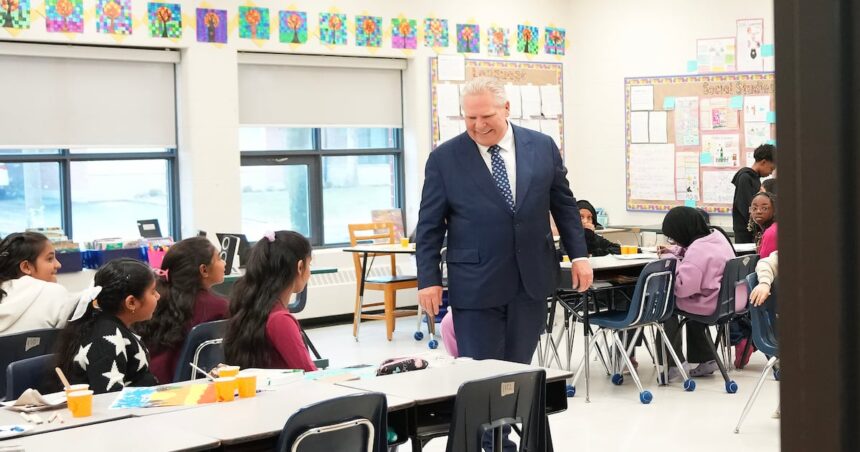

The question hanging over Ontario’s education system isn’t getting a clear answer from Queen’s Park, and that silence is making a lot of people nervous.
Premier Doug Ford won’t confirm whether school board trustees will appear on election ballots this fall. That’s a big deal for anyone who cares about local education decisions. I’ve covered enough political stories to know when vagueness signals something significant brewing behind closed doors.
The premier’s refusal to commit either way comes as his government reviews the entire trustee system. This isn’t just administrative shuffling. We’re talking about fundamentally changing how Ontarians have their say in education governance.
School board trustees make decisions that affect thousands of Toronto families every single day. They vote on budgets, approve school closures, and shape curriculum implementation. These aren’t distant bureaucrats. They’re elected community members who answer directly to parents and taxpayers.
Ford has hinted at major reforms without providing specifics. That lack of clarity creates uncertainty for current trustees, potential candidates, and voters alike. Election preparations typically begin months in advance, and we’re running out of runway.
Education Minister Stephen Lecce echoed the premier’s non-committal stance during recent media availabilities. He emphasized the government’s commitment to “accountability” and “efficiency” without addressing the fundamental question voters need answered.
I spoke with several Toronto school board trustees who requested anonymity given the political sensitivity. One veteran trustee told me the ambiguity makes planning impossible. Another described feeling like they’re operating in limbo, unsure whether to prepare for re-election or wind down their work.
The Toronto District School Board represents roughly 247,000 students across 582 schools. The Toronto Catholic District School Board serves another 92,000 students. These are massive institutions requiring informed oversight from people who understand community needs.
Local trustee elections typically draw modest voter turnout compared to mayoral or council races. That reality has prompted questions about their relevance and cost-effectiveness. Critics argue trustees wield limited power while drawing public salaries and benefits.
Supporters counter that trustees provide essential democratic accountability. They give parents and community members direct access to education decision-makers. Without elected trustees, school boards would answer only to the provincial government.
The Ford government has already consolidated public health units and restructured regional governments. Education governance reform fits that broader pattern of centralizing authority. Whether that’s good or bad depends largely on your perspective about local versus provincial control.
Toronto has always prided itself on strong local institutions. Our school boards reflect neighborhood diversity and respond to specific community priorities. A more centralized system might sacrifice that responsiveness for consistency.
Financial considerations probably factor into the government’s thinking. Trustee salaries, benefits, and election costs add up across Ontario’s 72 school boards. Eliminating those expenses could redirect funds toward classrooms, at least in theory.
But democracy costs money. That’s not a bug, it’s a feature. The question becomes whether the savings justify reducing voter choice and local representation.
I’ve watched Toronto’s education debates up close for years. School board meetings can get heated when trustees grapple with contentious issues like school boundaries, special education funding, or facility upgrades. That passion reflects genuine community investment.
Appointed administrators might make more technically efficient decisions. They’d probably generate fewer headlines and controversies. Whether they’d serve students and families better remains debatable.
The timing creates practical complications beyond the political symbolism. Municipal elections happen alongside trustee elections in Ontario. Separating them or eliminating trustee races entirely would require legislative changes and logistical adjustments.
Election officials need clear direction soon. Printing ballots, recruiting poll workers, and setting up voting locations demands lead time. The longer Queen’s Park waits, the more chaotic implementation becomes.
Some education advocates worry this represents another step toward reducing public input in education policy. Ontario parents already feel disconnected from curriculum decisions and standardized testing changes. Removing their ability to elect trustees would deepen that disconnect.
Others see potential for improvement if the government replaces elections with a better accountability mechanism. Perhaps appointed trustees with specific qualifications could bring expertise current elections don’t guarantee.
The uncertainty affects more than just trustees themselves. Potential candidates need to know whether they should start campaigning. Community groups that organize voter education need to know what they’re educating voters about.
I find the government’s silence particularly frustrating as someone who values transparency in public decision-making. Voters deserve time to understand changes affecting their democratic rights. Springing major reforms at the last minute disrespects that principle.
Toronto’s education landscape already faces significant challenges. Teacher shortages, infrastructure needs, and pandemic recovery consume board attention and resources. Adding governance uncertainty complicates an already difficult situation.
The premier’s office hasn’t provided a timeline for announcing the decision. That suggests internal deliberations continue or political considerations are delaying the reveal. Either way, the clock keeps ticking toward fall.
Whatever the government decides will set precedent for local democracy in Ontario. If trustees disappear from ballots, what other local positions might face similar scrutiny? The implications extend beyond education into broader questions about citizen participation.
I’ll be watching closely as this develops. Toronto families, education workers, and anyone who values local democratic input should pay attention too. The answer, whenever it comes, will shape how we govern schools for years ahead.