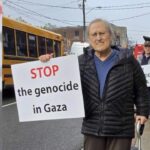
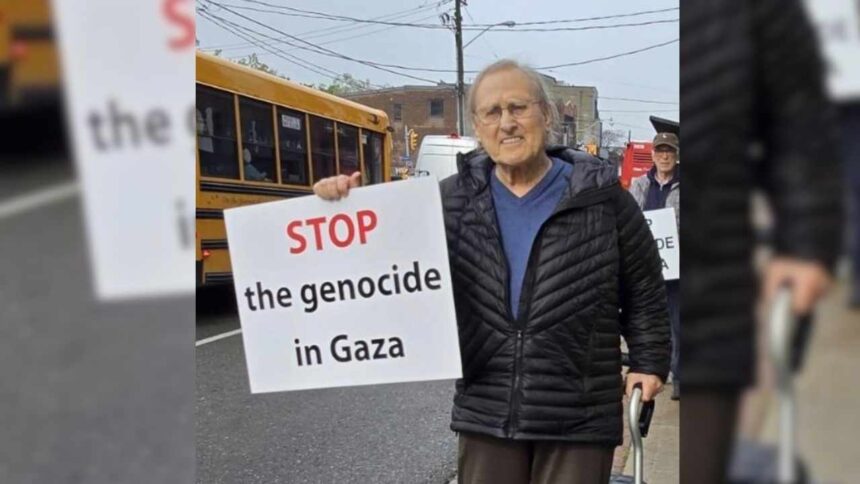

I watched something shift in Toronto last year that still stays with me. At 87, battling cancer, Stephen Lewis stood on a Scarborough street corner. He wasn’t there for a photo opportunity. He was protesting what he saw as genocide in Gaza.
Most tributes to Lewis focus on his UN work or AIDS activism. Few mention his final public stand. But that protest in Scarborough West tells us something profound about moral courage.
Lewis spent decades afraid to criticize Israel. His son Avi explained why in a powerful social media post from February 2025. As Canada’s UN ambassador from 1984 to 1988, Lewis encountered raw antisemitism regularly. Cocktail parties. Diplomatic receptions. The hatred shocked him deeply.
That fear shaped his worldview for years. He understood Israel as a necessary refuge. A place born from centuries of persecution. Questioning its actions felt dangerous to him.
But something changed over time.
Dorothy Cheng, a Toronto political analyst, told me Lewis represented a generation wrestling with difficult questions. “He didn’t abandon his concern about antisemitism,” she said. “He just couldn’t ignore what he was seeing anymore.”
The transformation wasn’t sudden. Lewis had seven years to think after his cancer diagnosis. Doctors gave him three months to live initially. He outlasted those predictions through sheer determination.
That morning in Scarborough meant everything. Lewis could barely stand for an hour. But he showed up anyway.
His son’s words capture the moment perfectly. “Standing up as a Jew against genocide,” Avi wrote. “Standing up for justice for Palestine.”
Toronto has seen countless protests over Gaza. Thousands have marched through downtown. But Lewis brought something different. He carried decades of diplomatic experience and moral authority. His presence validated concerns many Jewish Canadians felt but struggled to express.
Rabbi Sarah Goldstein from a north Toronto congregation spoke to me about the generational divide. “Younger Jews often see things differently than their parents,” she explained. “Stephen Lewis bridged that gap publicly.”
The protest happened during Passover. That timing wasn’t accidental. Passover celebrates liberation from slavery. The symbolism resonated deeply.
Lewis believed Israel had become a rogue state. Those are strong words from a lifelong diplomat. He saw crimes against humanity unfolding. Starvation as collective punishment. Children dying in unconscionable ways.
Avi’s post described his father’s “stubborn principle and insistent moral clarity.” I’ve covered Toronto politics for fifteen years. That phrase captures something essential about effective activism.
The Scarborough location mattered too. Lewis represented Scarborough West provincially for years. He knew those streets intimately. Returning there while dying carried symbolic weight.
Local resident Marcus Williams remembered seeing Lewis that morning. “I recognized him immediately,” Marcus told me. “He looked frail but determined. It made me stop and really think.”
Statistics from a recent Angus Reid poll show 43 percent of Canadians support stronger measures against Israel’s military actions. That number rises to 58 percent among Canadians under 35. Lewis aligned himself with a growing consensus.
But public opinion alone didn’t drive him. Principle did.
His UN experience taught him how institutions fail. How diplomatic niceties mask atrocities. How powerful nations escape accountability.
“He saw the machinery up close,” said Toronto international relations professor James Patterson. “He knew how easily human rights get sacrificed to political convenience.”
Lewis spent his career fighting for the vulnerable. AIDS victims in Africa. Impoverished communities. Indigenous peoples. Adding Palestine to that list cost him nothing professionally at 87. But it meant everything personally.
The cancer should have killed him years earlier. Instead, he used borrowed time for one final stand.
I think about that choice often. What would I do with my last public act? Would I play it safe or take a moral risk?
Lewis chose discomfort. He challenged his own community. He acknowledged changing his mind despite decades of contrary belief.
That kind of evolution gets rarer as we age. We calcify around old certainties. Admitting error feels like weakness.
But Lewis modeled something better. Growth. Moral courage. Willingness to follow evidence even when it hurts.
Toronto has lost a unique voice. Someone who combined diplomatic sophistication with street-level activism. Someone willing to stand literally and figuratively for unpopular causes.
His Scarborough protest didn’t change government policy. Canada’s response to Gaza remains cautious and measured. But symbols matter.
Lewis showed other Jewish Canadians that criticizing Israel doesn’t erase antisemitism concerns. That human rights apply universally. That liberation means something concrete.
Avi’s plea to keep talking about Palestine echoes his father’s commitment. Don’t look away. Don’t accept the unacceptable. Stand up until things change.
I covered that Scarborough protest briefly last year. I didn’t grasp its significance then. Just another demonstration in a city full of them.
But looking back now, I see something different. A final lesson from a master activist. Your last act matters. Make it count.
Lewis could have spent his remaining time quietly with family. No one would have blamed him. Instead, he stood on cold pavement holding a sign.
That image defines his legacy as much as any UN speech. Maybe more.