
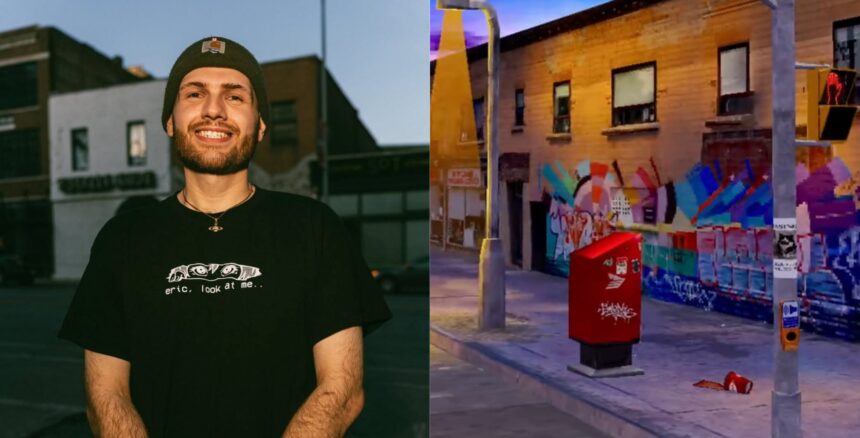

Walking through the Annex last week, I stumbled across something that stopped me mid-stride. Someone had taken our brick-lined streets and transformed them into something straight out of a PlayStation 2 game. The colors popped with that unmistakable early-2000s glow. I had to know more about the artist behind this nostalgic reimagining of Toronto.
Eric Godlow arrived in the Greater Toronto Area back in 2023 from Winnipeg. He came here as a musician, chasing creative opportunities in Canada’s largest city. But like many artists before him, he hit a wall. Writer’s block gripped his songwriting process, leaving him frustrated and creatively drained.
Most people would have pushed through or taken a break. Godlow chose a completely different path. He picked up 3D animation, teaching himself from scratch using free tools and YouTube tutorials. No formal training, no art school background, just raw determination and a creative itch that needed scratching.
The transition surprised even him. Godlow admits he struggles with traditional drawing. His hands don’t naturally translate ideas onto paper the way some artists manage. But 3D modeling offered something different, a digital playground where he could build entire worlds pixel by pixel.
He downloaded Blender, a free animation software used by professionals worldwide. Then he started learning, watching countless tutorials, experimenting with textures, and slowly figuring out how light behaves in virtual spaces. The learning curve was steep, but Godlow had time and motivation on his side.
Toronto’s architecture fascinated him from the start. Growing up in Winnipeg meant experiencing a completely different urban landscape. The Victorian-era houses scattered throughout neighborhoods like Cabbagetown and the Annex caught his attention immediately. These weren’t just buildings to him. They represented visual storytelling opportunities waiting to be explored.
In March 2025, Godlow started creating animations that blended Toronto’s real streets with retro video game aesthetics. Think Grand Theft Auto Vice City meets Toronto’s Queen Street West. The style resonated with anyone who spent their teenage years glued to a console controller.
Creating these animations demands serious time investment. A single ten-second clip takes between twenty and thirty hours to complete. Every element gets modeled from scratch. Street signs, brick textures, window frames, even the specific graffiti tags that appear on certain walls throughout the city.
Godlow pays attention to details most people overlook. He recreates artist stickers plastered on telephone poles. He mimics the exact way light hits certain corners during golden hour. These cultural Easter eggs make his work feel authentically Toronto, not just generic cityscapes with our name attached.
The iconic McDonald’s at Queen Street West and Spadina became one of his most requested pieces. That location holds special meaning for countless Torontonians. Late-night meetups, post-concert food runs, random Sunday afternoon hangouts. Godlow himself didn’t have personal history there, but he recognized its importance to the community.
On social media platforms, Godlow operates under the name emberlite. His animations have racked up hundreds of thousands of views across TikTok, Instagram, and YouTube. The response has been overwhelmingly positive, with viewers sharing deeply personal reactions to his work.
One TikTok user commented about moving away from Toronto nearly two years ago. Seeing Godlow’s animations brought back feelings of home, triggering memories of streets they used to walk daily. That kind of emotional connection represents exactly what Godlow hoped to achieve when he started this project.
Multiple commenters have expressed desire for a full Toronto-based video game using his visual style. They imagine wandering through digitally recreated neighborhoods, exploring virtual versions of their favorite spots. The demand for interactive experiences using his aesthetic has been consistent and growing.
Godlow is already working toward making that dream reality. He’s currently learning game development alongside his animation work. His ultimate goal involves creating an open-world video game where users can virtually walk through Toronto’s streets, experiencing the city through his nostalgic retro filter.
The technical challenges are significant. Game development requires different skills than animation. Interactive environments need optimization, collision detection, and gameplay mechanics that static animations don’t require. But Godlow has already proven his ability to teach himself complex creative skills.
As a business reporter, I’ve covered countless Toronto creative entrepreneurs. What strikes me about Godlow’s approach is his genuine passion over profit motive. He’s not chasing brand deals or monetization strategies first. He’s creating art that resonates emotionally with viewers, letting commercial opportunities follow naturally.
Toronto’s creative economy thrives on artists like Godlow. People who see our city differently, who transform familiar streets into something unexpected. According to Toronto’s 2024 Creative Industries Report, the sector contributes over $14 billion annually to our local economy. Individual creators increasingly drive that growth.
His work also taps into powerful nostalgia markets. A 2024 study from Ryerson University’s Creative Industries Institute found that retro-styled digital content generates 40% higher engagement than contemporary designs among millennials and Gen Z audiences. Godlow stumbled into this sweet spot naturally.
The musician-turned-animator hasn’t abandoned his original creative outlet entirely. He’s now incorporating his animations into music videos for his songs, blending audio and visual storytelling in ways that enhance both mediums. This cross-pollination of creative skills represents the modern artist’s reality.
When Godlow reflects on moving to Toronto, his enthusiasm comes through clearly. He calls it the best decision he ever made. Despite the creative struggles that pushed him toward animation, he found new artistic directions he never anticipated exploring.
I’ve walked Toronto’s streets for years covering stories. Sometimes you need fresh eyes to see what’s always been there. Godlow brings that outsider perspective combined with genuine appreciation for our city’s unique character. His work reminds us that Toronto deserves celebration, not just documentation.
The requests keep flooding in. Different neighborhoods, specific intersections, beloved local landmarks. Each animation takes substantial time, but Godlow says the hours disappear when he’s immersed in the work. That’s how you know someone has found their creative calling.
Toronto’s visual identity constantly evolves through artists who choose to interpret rather than simply reproduce. Godlow’s retro video game aesthetic adds another layer to how we understand and appreciate our urban landscape. It’s nostalgia meets现实, pixels meets pavement.